Ant control for Amarillo homes and kitchens
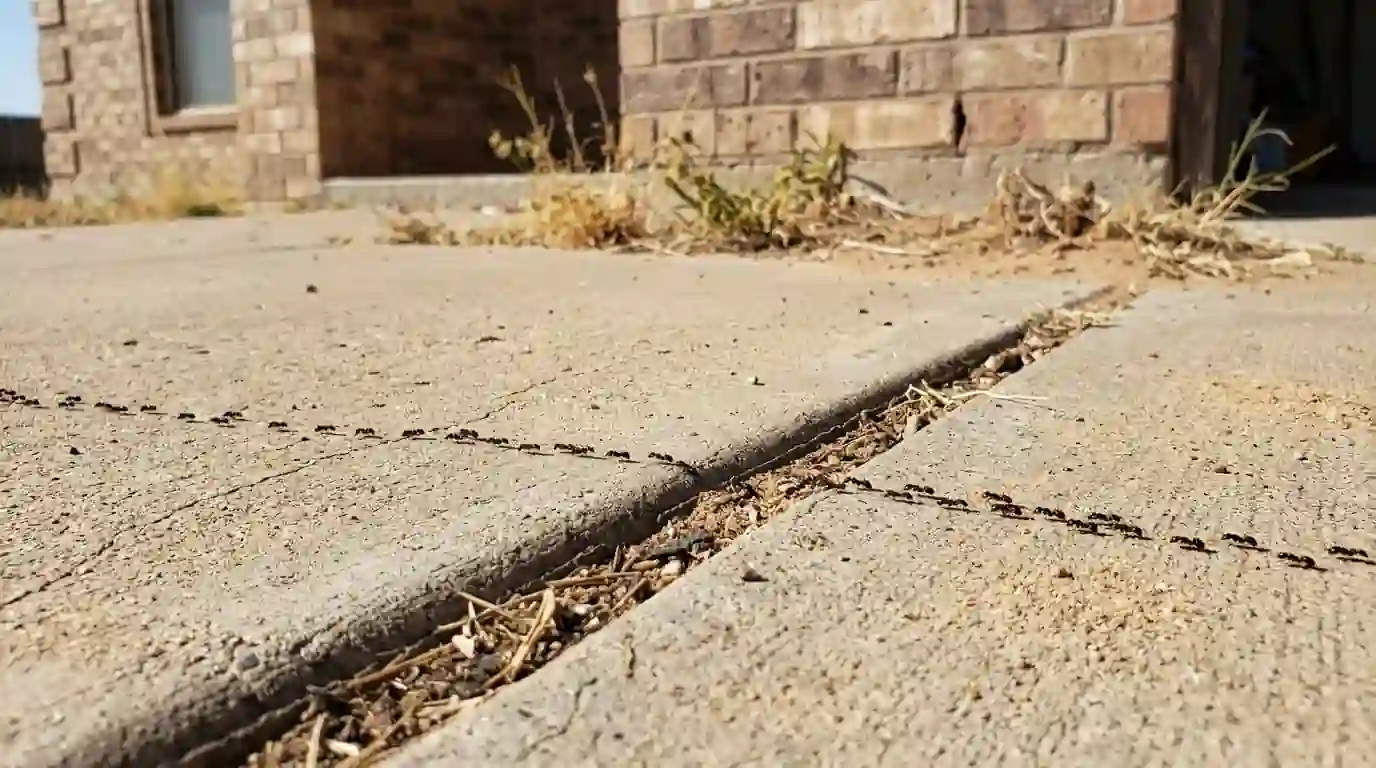
Ants trailing along a baseboard or pushing sand up through a slab crack usually mean a colony is nesting close by, often under the house itself.We find where the trail starts, match the bait or barrier to the species, and we answer 24/7.
How do you get rid of ants that keep coming into an Amarillo house?
You get rid of house-invading ants by killing the colony, not the trail. Our technician identifies the species, follows the trail back to its entry point, places slow-acting bait where workers feed, and treats the outside slab edge with a non-repellent barrier. You keep counters and sinks dry, skip store sprays that scatter the colony, and expect activity to fade over one to two weeks.
Signs the ants are nesting in or under your house
A few scouts on the counter is one thing, but these clues point to a colony that has settled in close.
Sand piles at slab cracks
Small heaps of fine soil along garage expansion joints, sidewalk seams or the edge of a patio are the calling card of pavement ants tunneling under the concrete.
The same trail every day
A steady line that follows one path, usually along a kitchen baseboard or the back edge of a countertop, means workers have a reliable route from the nest to food.
A rotten coconut smell
Odorous house ants give off a sour, coconut-like odor when crushed. If wiping up a trail leaves that smell on the paper towel, you know which ant you are dealing with.
Ants at the sink and dishwasher
Ants gathering under the sink, along the dishwasher door gasket or around the ice maker line are after water as much as food. This is common in long dry spells.
Winged ants indoors
Swarmers coming out of a wall, a window frame or a crack in the slab inside the house mean a mature colony is close enough to release them indoors.
Bare circles in the yard
A cleared disc of soil several feet across with a hole near the center, usually in a sunny open spot, is a red harvester ant mound.
Why store-bought spray often makes ant trouble worse
Most spray from the hardware store kills on contact and repels everything else. That sounds useful until you know how odorous house ants and pavement ants are built. Their colonies can have many queens, and when a repellent cuts a trail or kills off foragers, the colony can split into several smaller colonies that settle into new wall voids and slab cracks. A kitchen with one trail in May can have trails in three rooms by July after a few rounds of spraying.
Bait works the other way. Workers find it, feed on it and carry it back to share with larvae and queens, so the active ingredient reaches the part of the colony you never see. A non-repellent liquid outside, such as Termidor or Alpine, works on the same idea: ants walk through it without noticing and carry it home. The trade is patience. Bait can take several days to a couple of weeks to finish a colony, and you will see ants feeding on it in the meantime, which is a good sign.
What our technician does on an ant visit
Ant work starts with patience on our side, because the trail tells us where everything should go.
Identify the ant
We look at the workers up close, note their size and color, and check for the crushed-coconut smell. Pavement ants, odorous house ants and harvester ants each call for a different bait and placement.
Follow the trail to the entry
Our technician traces the line from the food back to where it enters. That is often a gap at the slab edge, a weep hole in the brick, a window frame or the hole where a plumbing line comes through the wall.
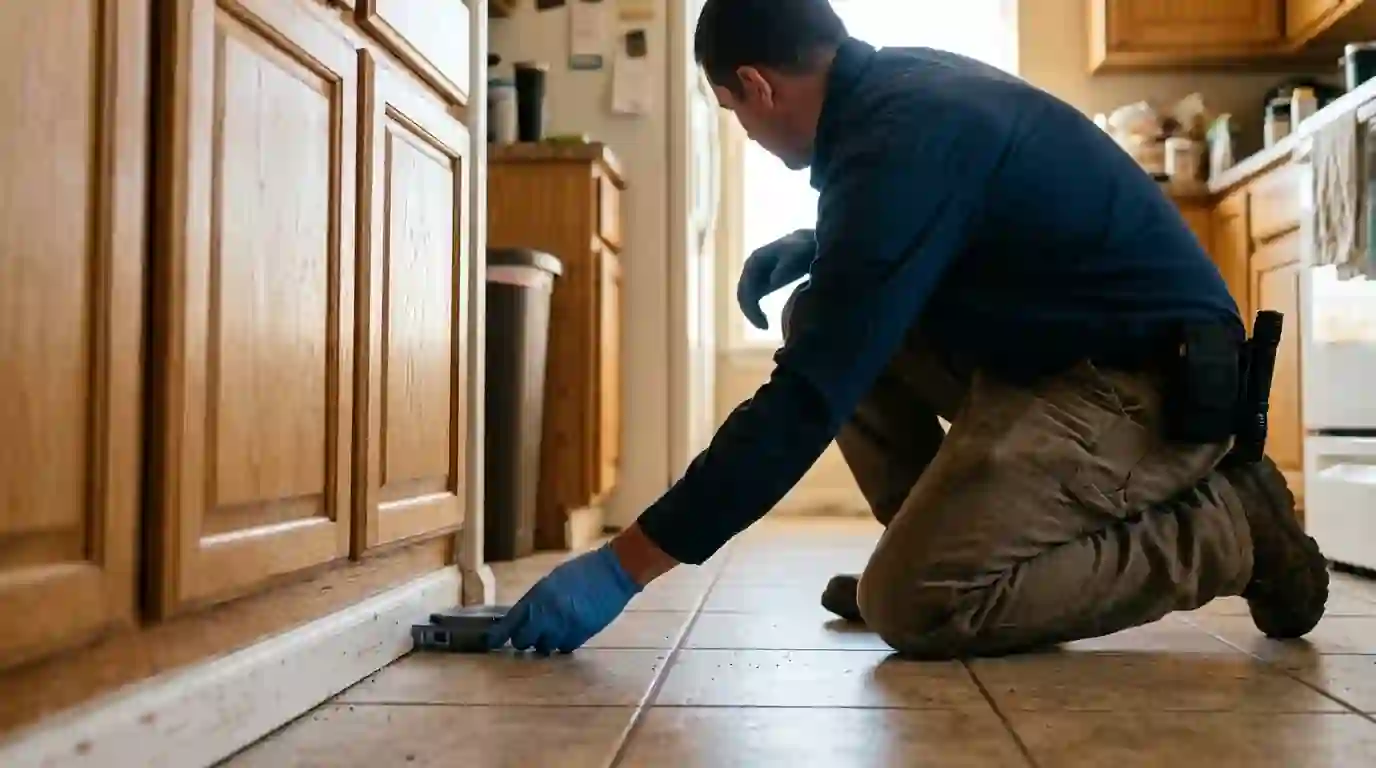
Place bait on the active trail
Gel bait such as Advion goes in small dabs beside the trail, behind appliances and in cracks where kids and pets cannot reach it. We match sugar or protein bait to what the ants are taking that week, since colonies switch preference through the season.
Treat the outside perimeter
Outside, we apply a non-repellent band along the foundation, around door thresholds and at the slab edge where trails come in. Granular bait goes along sidewalk seams and driveway joints where pavement ants are pushing up sand.
Handle yard mounds separately
Harvester ant mounds are treated directly at the nest opening with a product labeled for them. We do not dig mounds up, because that only sends the colony to rebuild a few feet away.
Check back on stubborn trails
If a trail is still running after about two weeks, we come back, look for a second colony and adjust the bait.
Need ant control in Amarillo?
Call and tell us what you are seeing. The line is answered 24 hours a day, every day.
Why ants trail indoors after Amarillo storms and dry spells
Amarillo gets about 19.7 inches of precipitation in a normal year, and roughly three quarters of it falls between April and September, mostly in thunderstorms. Those storms soak the heavy clay soil fast. Colonies nesting under slabs and sidewalks move up and out when the ground floods, and a kitchen at the edge of a slab is a dry, warm place to land. That is why fresh ant trails often appear a day or two after a big storm rolls through.
The opposite happens in a long dry stretch. Texas A&M AgriLife notes that heat and drought push insects indoors looking for water, and ants are no exception. In a hot, rainless spell of summer, trails head straight for sinks, dishwashers, pet water bowls and the drip from a refrigerator ice maker line. Fixing a slow leak under the sink can do as much good as any bait placement.
Housing plays a part too. Most Amarillo homes are brick ranches on concrete slabs, and the joint between the slab and the brick veneer is a highway for pavement ants. Weep holes at the base of the brick give them another door. On the newer south and southwest edges of town, where yards border open pasture, harvester ants clear their mounds in sunny, sparse ground, sometimes right in a new lawn that has not filled in yet.
Which ant is in your Amarillo house?
Here is how to tell the common Panhandle ants apart, and what tends to work on each.
| Ant | What it looks like | Where you find it | What works |
|---|---|---|---|
| Pavement ant | Dark brown to black, about 1/8 inch, grooved head | Slab cracks, garage joints, sand piles along sidewalks | Granular and gel bait, plus a band at the slab edge |
| Odorous house ant | Small, dark brown, coconut smell when crushed | Kitchens, bathrooms, wall voids, under mulch outside | Sweet bait indoors, non-repellent liquid outside |
| Red harvester ant | Larger, red to rust colored, painful sting | Cleared bare circles in sunny yards and lots | Direct mound treatment, no digging |
| Winged swarmers | Ants with wings, often after warm rain | Window frames, slab cracks, near lights | Note where they came out so we can find the colony |
What you can do between ant visits
These small habits keep ants from finding a reason to stay.
- Wipe counters at night and rinse sticky jars, syrup bottles and soda cans before they go in the recycling.
- Keep pet food in a sealed bin and pick up bowls after feeding.
- Fix dripping faucets and check the water line behind the refrigerator for slow leaks.
- Leave bait placements alone, even when ants crowd them; that crowd is the colony getting dosed.
- Do not spray store insecticide over or around the bait.
- Trim shrubs and ground cover so they do not touch the siding, and keep mulch pulled back from the brick.
What changes the cost of ant control in Amarillo
No two ant jobs are quite the same, so the price follows what we find.
- Species
- Odorous house ants that have already budded into several colonies take more visits than a single pavement ant colony under a driveway.
- How many colonies
- One trail in the kitchen is a smaller job than trails in the kitchen, both bathrooms and the garage.
- Earlier spraying
- A colony that has been sprayed repeatedly and split takes more bait placements and a return visit to catch every piece.
- Yard mounds
- Harvester ant mounds are treated one by one, so a big lot with many mounds adds time.
- One visit or a plan
- Ants that come back every spring are often better covered by a quarterly plan than by separate visits.
We quote after an inspection, or over the phone once we know the ant, the rooms involved and what has already been tried.
Product lines a technician may choose from, matched to the pest, the room and who lives there:
Where we handle ant control
Neighborhoods and towns we cover most often, with ZIP codes. The rest of Amarillo and the towns in our service area are covered too.
- City View79118
- Puckett79109
- Ridgecrest79109
- Sleepy Hollow79121
- Hollywood-Scotsman79110
- Windsor79109
- Belmar79106
- The Greenways79119
- Heritage Hills79119
- South Georgia Place79110
- Wolflin79109
- Eastridge79107
- Canyon79015
- Hereford79045
- Pampa79065
- Dumas79029
- Borger79007
- Bushland79012
Ant Control questions from Amarillo homeowners
Why do ants come back to my Amarillo kitchen every time I spray them?
Because the spray only kills the workers you can see, while the queens and larvae sit untouched in a wall void or under the slab. Odorous house ants and pavement ants can respond to repellent spray by splitting into new colonies, so the problem spreads. Slow-acting bait that workers carry home is what finishes the nest. Stop spraying near the trail and let the bait work.
Are red harvester ant mounds in my Amarillo yard a danger to kids and dogs?
They can be. Red harvester ants sting rather than just bite, and the sting hurts enough that a curious dog or a toddler sitting near a mound will notice right away. They are not aggressive away from the mound, so the risk is mostly people and pets stepping on the cleared area. We treat mounds directly and show you where to keep the kids clear until activity stops.
How long does ant bait take to clear odorous house ants?
Usually one to two weeks. In the first few days you may see more ants, because workers crowd the bait and recruit others to it. That is the bait doing its job. Activity should drop sharply in the second week. If a trail keeps going past about two weeks, there is usually a second colony, and we come back to find it.
What does sand coming up through cracks in my garage slab mean for ants?
It almost always means pavement ants are tunneling underneath and carrying soil to the surface. The piles show up along expansion joints, where the slab meets the driveway and at sidewalk seams. Sweeping it up does nothing to the colony. Granular bait worked into those joints, plus gel bait on any trail inside the house, is how we handle it.