Pest control and exterminator service in Amarillo, TX
Amarillo pests change with the side of town and the month: termites swarm in April and May, scorpions drop out of summer attics, and mice push indoors after the first freeze.We answer 24/7 and work every neighborhood from our south Amarillo office.
Office: Lamount Dr, 79110Potter and Randall counties
What pests should Amarillo homeowners expect, and how do you treat them?
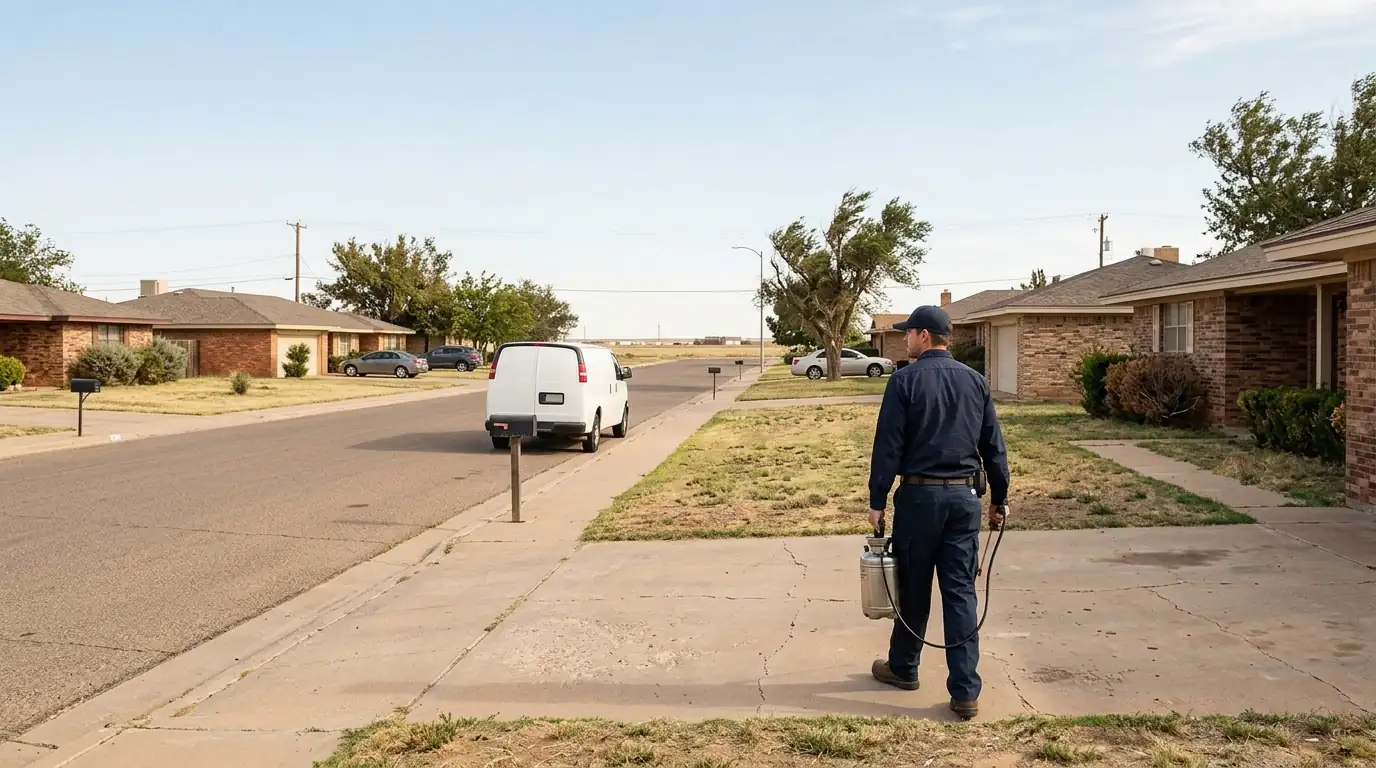
Most Amarillo homes see a yearly rotation: termite swarms in April and May, miller moths in late spring, scorpions and brown recluse in summer heat, crickets and millipedes in fall, and mice after the first freeze around October 20. We inspect the slab edge, weep holes, attic and garage, treat where each pest actually lives, and seal the gaps that let it in.
How pest problems differ between north and south Amarillo
Amarillo straddles two counties, and the split roughly follows the age of the housing. The Potter County side takes in north Amarillo and west side neighborhoods. Eastridge, off NE 23rd Ave, is mostly brick ranch homes from the 1950s and 1960s, while Olsen Park's mid-century homes and Belmar's 1960s and 1970s houses sit near Westgate Mall. Mortar crumbles at weep holes, door sweeps wear thin, and gaps open around gas and water lines. A house mouse needs a gap only about a quarter inch wide, so a lot of our north side work is sealing rather than spraying.
The Randall County side holds most of the city's growth. Western Plateau, Puckett and Ridgecrest went up from the 1950s through the 1980s, but The Greenways, Heritage Hills, The Colonies and Hillside Terrace were built from the late 1990s on, and City View is still adding streets. On that southwest edge, back fences face open pasture. Grading pushes mice, snakes and field crickets toward the nearest shelter, and a prairie dog colony can sit one fence line away. Calls there lean toward scorpions, crickets and the odd snake in a garage.
Some things are the same on both sides. The striped bark scorpion lives across the whole city and spends hot weather in attics. Brown recluse turn up in garages and stored boxes from Eastridge to Heritage Hills. And when Texas A&M AgriLife describes pests coming indoors during heat and drought to find water, that applies to every ZIP in town.
Why a 1920s Wolflin house and a new City View house need different plans
The older central neighborhoods carry their own set of problems. Wolflin Place went up in 1923 and Wolflin Estates in 1927, South Lawn filled in with bungalows and ranch homes in the 1940s and 1950s, and San Jacinto holds the Route 66 Sixth Street historic district. Homes from the 1920s to the 1940s are more likely to sit on pier-and-beam foundations with crawlspaces. A crawlspace gives skunks a winter den, lets mice travel unseen from one end of the house to the other, and puts floor framing close to soil where subterranean termites work. Wolflin's streets are lined with Siberian elms, the favorite tree of the elm leaf beetle, and adult beetles crawl into warm, dry spots in homes each fall. Fox squirrels follow those same tree-lined blocks.
The newest subdivisions on the south and southwest edge are built on slabs with brick veneer and weep holes. They're tighter houses, but they sit on freshly graded ground next to pasture, with new landscape beds and drip irrigation keeping soil damp against the foundation. Scorpions and crickets come in through weep holes and under garage doors, snakes follow mice out of disturbed fields, and termites find any spot where mulch or soil has been piled above the slab line.
So the visit changes. In an older home, our technician spends time in the crawlspace checking for mud tubes on piers, droppings and gaps in the skirting. In a new home, the time goes to the slab perimeter, the weep holes, the garage and the attic.
Pest problem in Amarillo?
Call and describe it. The phone is answered 24 hours a day.
What Amarillo pests do through the year
Our climate swings hard, and pest activity follows the calendar closely.
| Months | What we see most | Where it shows up |
|---|---|---|
| January to March | House mice, skunks breeding, boxelder bugs on warm afternoons | Kitchens and garages, under porches and crawlspaces, sunny south walls |
| April and May | Termite swarmers after the last freeze, miller moths, brown recluse mating season begins | Windowsills near the slab, porch lights and garage doors, closets and stored boxes |
| June to August | Scorpions, mosquitoes, snakes, paper wasps | Attics and bathrooms, standing water, garages at the edge of town, eaves |
| August and September | Field crickets, yellowjackets at their peak | Door thresholds and weep holes, ground nests in lawns |
| September and October | Millipedes after fall rain, West Nile risk at its highest | Patios and entryways, shaded yards near water |
| Late October to December | Mice and spiders moving in after the first freeze | Utility gaps, garage door corners, attic insulation |
What happens on a first visit to an Amarillo home
The order is the same anywhere in town; what we find is not.
We start with what you've seen
You tell us what turned up, where and when. A scorpion in the bathtub in July points somewhere different than droppings in the pantry in November, so your account shapes the inspection.
Foundation and brick veneer
Our technician walks the foundation line, checking weep holes, soil and mulch height, mud tubes and the gaps where pipes and cables enter. On pier-and-beam homes, we look at crawlspace vents, skirting and access doors.
Garage, attic and utility closets
We check garage door seals and corners, the water heater closet and, when it's safe to reach, the attic. Scorpions, mice and wasps all leave evidence up there that you'd never see from the hallway.
Treatment where the pest lives
Bait goes into cracks for roaches, a band of material along the foundation and entry points, dust into wall voids, traps along rodent runways. We explain re-entry times and keep placements away from where kids and pets spend their time.
Sealing and a plan
Small gaps get sealed on the visit when that's practical. You get a plain rundown of what we found and whether a one-time visit or a quarterly schedule makes more sense for your house.
Amarillo fixes that keep pests out between visits
Most of these take a single afternoon.
- Keep soil and mulch a few inches below the top of the slab so termites can't build tubes out of sight.
- Run AC condensate lines and downspouts away from the foundation.
- Replace worn door sweeps and garage door bottom seals; if wind blows dust under a door, a mouse can fit too.
- Fit weep holes with vents made for brick veneer instead of mortaring them shut.
- Store garage items in lidded plastic tubs rather than cardboard, which brown recluse love.
- Switch porch and garage bulbs to yellow bug lights before miller moth and cricket season.
- Dump standing water weekly from June through October, since the city doesn't spray private yards.
Where our office sits and how we cover the whole city
Our office is at 231 Lamount Dr in south Amarillo, just off Hollywood Rd (Loop 335) in the Hollywood-Scotsman area. From there the southwest subdivisions and Canyon are a short drive, and I-27, I-40 and Loop 335 put the north side, the west side and the northwest hills within easy reach. We serve every residential ZIP in the city: 79101, 79102, 79103, 79104, 79106, 79107, 79108, 79109, 79110, 79118, 79119, 79121 and 79124.
Each neighborhood listed below has its own page with its housing era, nearby parks and open ground, and the pests we tend to find there. Phones are answered day and night, and same-day visits are often possible inside the city. Call (806) 552-3060 and tell us what you're seeing.
Amarillo neighborhoods we cover
Local notes for each part of town, from the pests we see most to the housing and landmarks that shape them.
- Belmar79106
- Bivins79102
- City View79118
- Eastridge79107
- Estacado79109
- Greyhawk Landing79119
- Hamlet79107
- Heritage Hills79119
- Hillside Terrace79119
- Hollywood-Scotsman79110
- North Heights79107
- Olsen Park79106
- Pleasant Valley79108
- Puckett79109
- Puckett West79121
- Quail Creek79124
- Ridgecrest79109
- Sleepy Hollow79121
- South Georgia Place79110
- South Lawn79110
- The Colonies79119
- The Greenways79119
- Tradewind Square79118
- Westcliff79124
- Western Plateau79109
- Westover Park79119
- Windsor79109
- Wolflin79109
- Woodlands79124
Pest control services for Amarillo
Home Pest Control
Spiders in the garage, crickets at the back door and a mouse behind the stove are everyday problems in Amarillo houses.
Quarterly Pest Control Plans
Panhandle pests arrive in waves: moths in spring, scorpions in summer, crickets in late summer and mice when the first freeze hits.
Scorpion Control
Striped bark scorpions climb into attics, then drop into bedrooms and bathtubs when the summer heat builds.
Termite Control
Native subterranean termites live in the soil under Amarillo and work their way into houses through mud tubes you rarely see.
Rodent Control
Droppings in a kitchen drawer or scratching in the attic at night usually mean house mice, and gnawed feed sacks in a barn often...
Brown Recluse Control
Brown recluses hide in closets, garages and stored boxes, and most people only notice them when one turns up in a shoe or a...
Mosquito Control
Mosquitoes biting on the patio at dusk usually mean they are breeding in standing water close to home, in a clogged gutter, a planter...
Pest control questions from Amarillo
Do Amarillo homes really get scorpions?
Yes. The striped bark scorpion lives throughout Texas, Amarillo included, and it climbs walls and spends hot weather in attics before moving down into rooms. Most calls come in summer heat. We treat the attic, the foundation line and weep holes, and seal gaps around doors and plumbing so fewer reach the bedrooms and bathrooms.
Does the City of Amarillo spray for mosquitoes in my yard?
No. The city treats more than 100 standing water sites, larvicides parks and ditches, and fogs from April to October based on trap counts and complaints, but it does not spray private property. Your yard is up to you. Dumping standing water every week does the most good, and we can treat shaded resting spots if mosquitoes keep you inside in late summer.
When do termites swarm in Amarillo?
In the Texas Panhandle, native subterranean termites swarm in April and May, usually on a warm day after rain. You may see winged insects near a window or find a pile of wings on a sill. The swarm itself is short, but it means a mature colony is close by, often already feeding in the house. Call for an inspection rather than spraying the swarmers.
Is pest control different on the Potter County and Randall County sides of Amarillo?
The methods are the same, but the focus shifts. Older Potter County neighborhoods on the north side tend to need more rodent sealing and crawlspace work. Newer Randall County subdivisions on the southwest edge see more scorpions, crickets and snakes pushed out by construction. We plan each visit around the house and the ground next to it, not the county line.