Attic cleanup and insulation replacement in Amarillo
Once mice, rats, raccoons, squirrels or bats are gone, the attic they lived in still holds droppings, urine-soaked insulation and a lingering odor.We remove the contaminated material, sanitize and deodorize the space, and blow in fresh insulation to the depth your attic should have.
How do you clean up an Amarillo attic after rodents or wildlife?
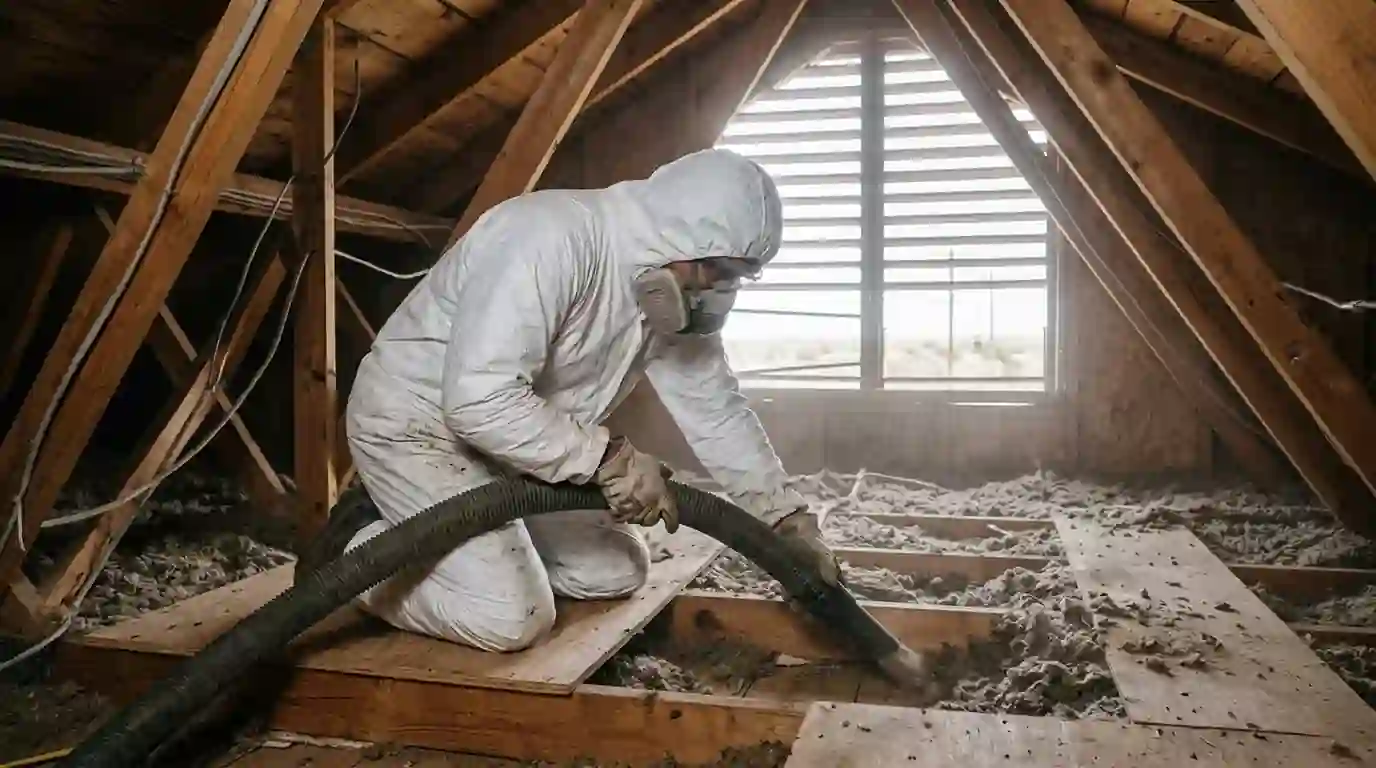
Cleaning an attic after rodents or wildlife starts with making sure the animals are out and their entry points are sealed. Then our technician wets down droppings and nesting with disinfectant instead of sweeping, removes and bags the contaminated insulation, sanitizes and deodorizes the framing and decking, and blows in new insulation, typically to the R49 to R60 range the Department of Energy suggests for Amarillo.
Signs the attic needs cleanup after animals move out
Most of these show up from the hatch or in the rooms below, and several together usually mean the insulation is past saving.
Droppings on the insulation
Scattered mouse or rat pellets, a pile of raccoon scat in one corner, or a dark mound of bat guano under a roof gap.
Trails and tunnels
Paths pressed flat through blown insulation, or tunnels running from the eaves toward the ductwork and the hatch.
Odor on hot afternoons
A sharp ammonia or musky smell drifting down through can lights and the hatch in summer, when attic heat bakes old urine.
Stains on the ceiling below
Yellow or brown rings on drywall where urine soaked through the insulation, often close to an outside wall.
Chewed wiring and ducts
Bare copper showing through gnawed wire jackets, or flexible duct wrap torn open by squirrels or raccoons.
Nesting packed at the eaves
Wads of shredded insulation, leaves, paper and fabric stuffed into the low corners where the roof meets the walls.
Why the animals have to be gone before cleanup starts
Blowing fresh insulation into an attic that still has mice in it just gives them a clean place to nest. So the first thing we check is whether the removal work is finished: rodents trapped out and catches stopped, raccoons or squirrels gone and their openings closed, bats excluded with one-way devices and the gaps sealed after they leave. Texas wildlife law permits taking bats out of occupied homes and workplaces, but no pesticide can be used on them, so exclusion is the only route.
If that work has not been done, it comes first, through our rodent exclusion, raccoon, squirrel or bat services. Raccoons have their young in April and May, so a spring attic may hold a litter that has to leave with the mother before anything else happens. Skipping this order is how cleanups fail: new insulation goes in, a soffit gap stays open, and droppings reappear on top within weeks.
If you are chasing a rotten smell from one animal that died in a wall or ceiling, dead animal removal is the better fit. Attic cleanup is the larger job of restoring a space that animals lived in for weeks or months.
What happens during an attic cleanup, step by step
Each step follows CDC guidance for rodent droppings, scaled up to the size of a full attic.
Inspect and measure
Our technician checks every section of the attic, notes where droppings, urine and nesting are heaviest, measures the depth of the existing insulation and looks over wiring and ductwork. You get a clear picture of what has to come out and what can stay.
Air out and protect the house
The attic is ventilated for about 30 minutes before work begins, and the path from the hatch through the house is covered. We wear gloves, respiratory protection and coveralls so nothing tracks down into living spaces.
Wet everything down first
Droppings, urine spots and nests are sprayed with a disinfectant or a 1 to 10 bleach and water mix and left to soak. Sweeping or vacuuming dry droppings throws dust into the air, so nothing gets moved until it is wet.
Remove contaminated insulation
Soiled insulation and nesting material are bagged, sealed and carried out. In heavy cases that means the whole attic floor; in lighter ones it may be the sections near the eaves and the nest sites.
Sanitize and deodorize
Exposed joists, top plates and decking are treated with disinfectant and an odor neutralizer. Raccoon latrine areas get extra care, because raccoon droppings can carry roundworm eggs.
Blow in new insulation
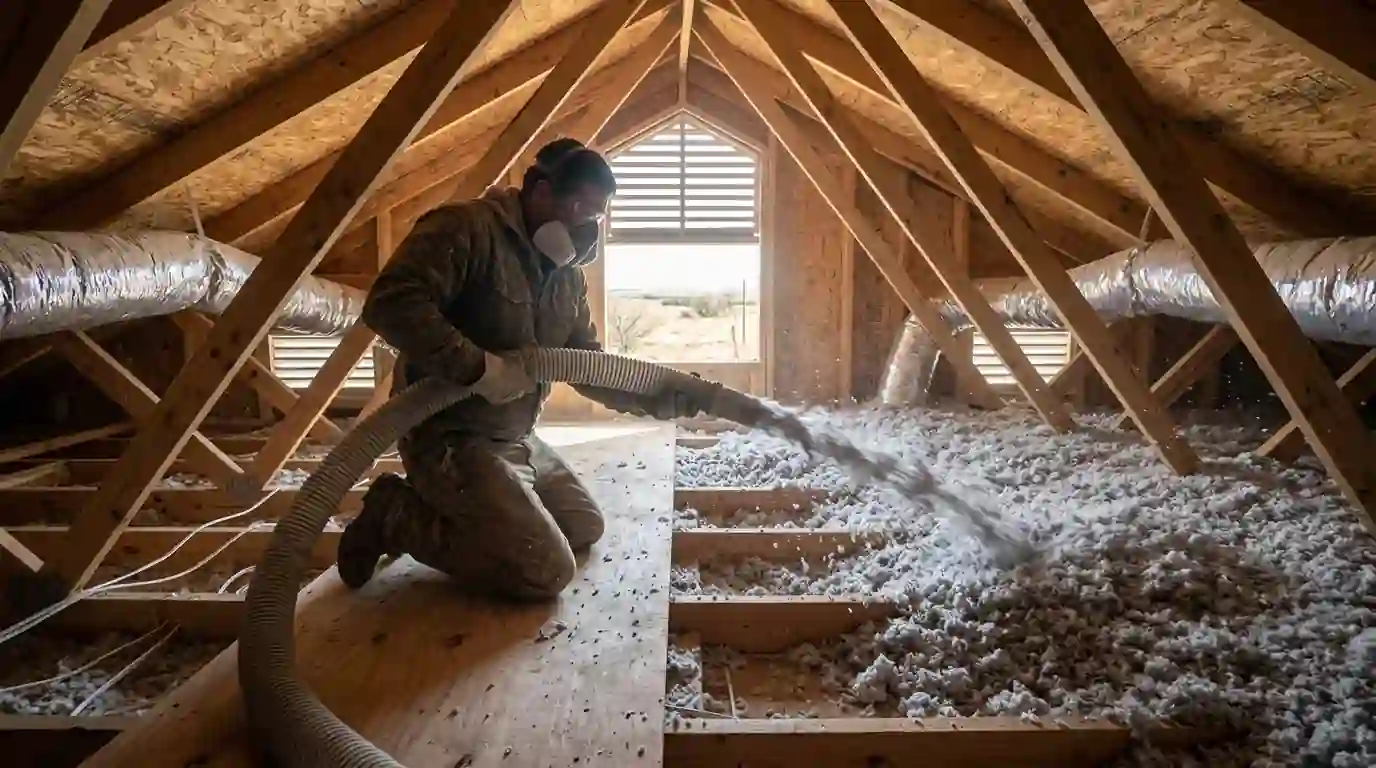
With entry points sealed and the attic clean, new insulation goes in to the depth you choose, usually R49 to R60 for an Amarillo attic. We show you the finished depth from the hatch before we leave.
Need attic cleanup & insulation in Amarillo?
Call and tell us what you are seeing. The line is answered 24 hours a day, every day.
The health reasons a dirty attic needs careful handling
Rodent droppings and urine are more than an odor problem. Deer mice are the main carrier of hantavirus in North America, and the virus spreads when dried droppings or nesting get disturbed and the dust is breathed in. Plenty of attic droppings come from house mice instead, but nobody can sort one from the other by eye, so we treat every attic as if the risk is real.
Raccoons bring a different hazard. They pick one or two spots as a latrine, and those piles can hold raccoon roundworm eggs, which is why that material is removed slowly and bagged on the spot. Bat guano builds into heaps under a roost and carries its own dust and smell, and it gets the same wet-first treatment.
That is why we ask homeowners not to climb up and sweep the attic, and never to run a shop vacuum over droppings, even when the mess looks small.
How much insulation an Amarillo attic should have
The Department of Energy places Amarillo in climate zone 4 and recommends roughly R49 to R60 of attic insulation for homes here: R60 when an attic starts out bare, and R49 when 3 to 4 inches are already in place. Either target means a layer well over a foot deep. Homes built in the 1920s to 1940s may never have had anything close to that, and many brick ranch homes from later decades have lost depth as insulation settled or got trampled.
Depth matters more than most people expect in this climate. Attics under a shingle roof get very hot in July, and a winter cold front here can knock 50 or 60 degrees off the thermometer in half a day. Insulation that rodents have tunneled, flattened or soaked holds far less air, and trapped air is what slows heat moving through the ceiling. A cleanup is the natural time to bring the attic back up to the recommended level, because the old material is coming out anyway.
What changes the cost of attic cleanup and insulation in Amarillo
Two attics of the same size can price very differently depending on what the animals left behind.
- Attic size
- Square footage sets how much material comes out and how much new insulation goes back in.
- Depth of the old insulation
- A deep layer of contaminated blown insulation takes longer to bag and remove than a few inches of old batts.
- How much is contaminated
- Spot cleanup around a nest near one eave is a much smaller job than stripping the whole attic floor after a long rat or raccoon problem.
- Access and working room
- A small hatch, a low-pitched roof, or ductwork and HVAC equipment crowding the attic floor all slow the work.
- Which animal it was
- Raccoon latrines and heavy bat guano need slower removal and more sanitizing than scattered mouse droppings.
- New insulation and target R-value
- Whether you add insulation, and whether you aim for R49 or R60, changes the amount of material and the time to blow it in.
We quote after an attic inspection, since the amount of contamination is hard to judge without seeing it.
How to get the house ready for attic cleanup day
A little prep makes the visit go faster and keeps dust out of your rooms.
- Clear a path from the front door to the attic hatch or pull-down stairs.
- Move cars out of the garage if the hatch is there, and clear shelves under the opening.
- Tell us about boxes or decorations stored in the attic, since they may need to be moved or cleaned first.
- Keep pets shut in a room away from the hatch for the day.
- Leave droppings in the attic alone; do not sweep, vacuum or spray them before we arrive.
- Write down where you heard noises and where ceiling stains have appeared.
- Mention any chewed wires you have spotted so they can be checked before insulation covers them.
Product lines a technician may choose from, matched to the pest, the room and who lives there:
Where we handle attic cleanup & insulation
Neighborhoods and towns we cover most often, with ZIP codes. The rest of Amarillo and the towns in our service area are covered too.
- City View79118
- Puckett79109
- Ridgecrest79109
- Sleepy Hollow79121
- Hollywood-Scotsman79110
- Windsor79109
- Belmar79106
- The Greenways79119
- Heritage Hills79119
- South Georgia Place79110
- Wolflin79109
- Eastridge79107
- Canyon79015
- Hereford79045
- Pampa79065
- Dumas79029
- Borger79007
- Bushland79012
Attic Cleanup & Insulation questions from Amarillo homeowners
Can new insulation go on top of rodent droppings in my attic?
It is not a good idea. Laying new insulation over droppings and urine traps the odor and contamination under the fresh layer, and the smell tends to come back on hot days. It also hides whether rodents are still active. The better order is to confirm the animals are out, remove the soiled material, sanitize the attic, then add insulation to the recommended depth.
What R-value of insulation should an Amarillo attic have after cleanup?
The Department of Energy recommends about R49 to R60 for climate zone 4, which includes Amarillo. R60 is the target for an attic that starts with no insulation, and R49 is suggested when 3 to 4 inches already exist. After a full cleanup where the old insulation comes out, the attic is effectively starting bare, so the R60 guidance is the one that applies.
Does bat guano in the attic need different cleanup than mouse droppings?
The basic method is the same: wet the droppings down, never sweep them dry, remove soiled insulation and sanitize. Bat guano tends to pile up in one or two spots under the roost rather than scattering, so the heaviest work is concentrated there. Bats also have to be excluded with one-way devices first, since Texas law does not allow pesticides on bats. Cleanup comes after they have left.
Why does the attic still smell after the squirrels were removed?
The urine, droppings and nesting they left behind are still up there. Squirrels soak insulation in the areas they use most, and Amarillo summer heat in the attic makes that odor stronger every afternoon. Removing the animals ends the noise, but the smell fades only when the soiled insulation comes out and the wood underneath is sanitized and deodorized. Sealing their entry hole keeps new squirrels from adding to it.