Wasp and yellowjacket removal in Amarillo
A paper wasp nest over the front door, yellowjackets streaming out of a hole in the lawn or buzzing inside a wall all call for careful handling.We identify the insect, treat or remove the nest safely and tell you what not to do while you wait. We answer 24/7.
How do you safely get rid of wasps and yellowjackets around an Amarillo home?
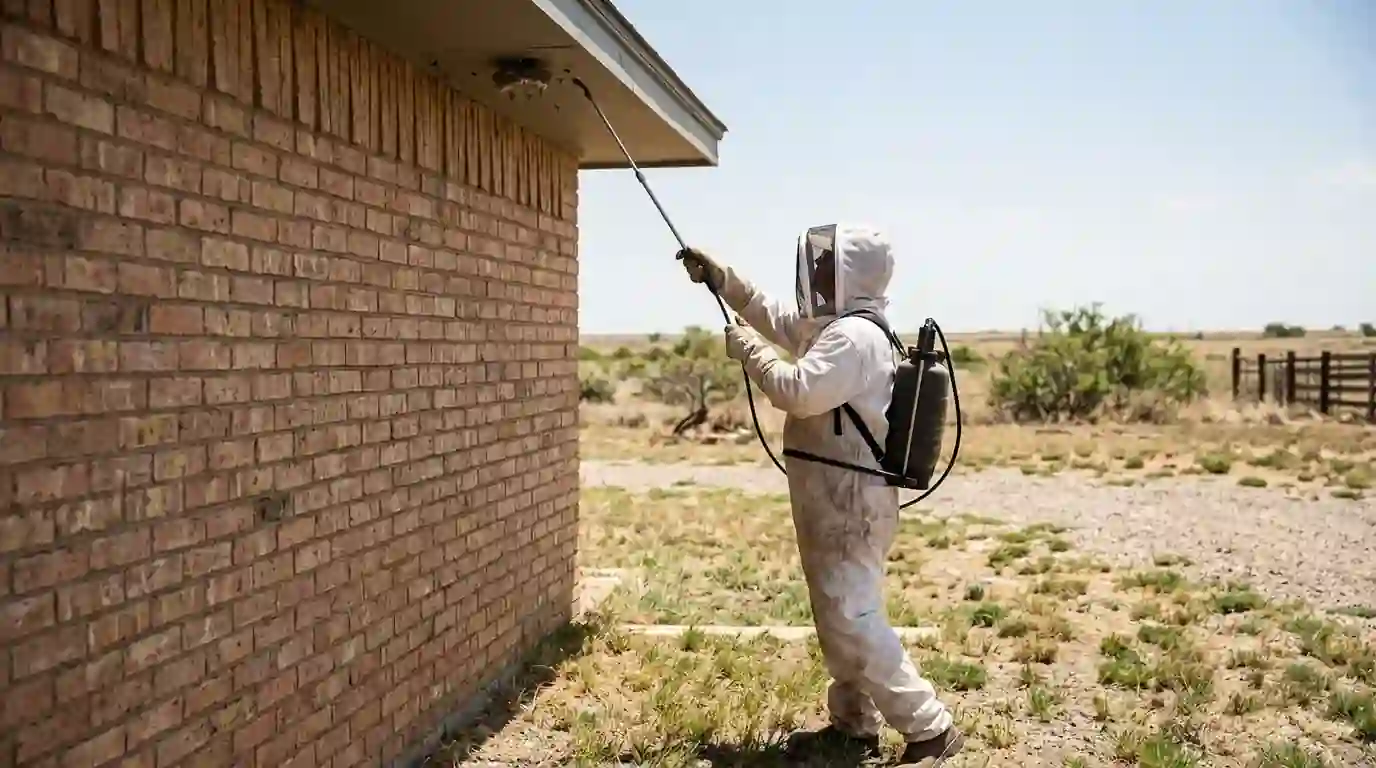
You get rid of wasps and yellowjackets by treating the nest directly, ideally when the colony is settled at dusk or early morning, then removing it once activity stops. Our technician identifies the species, treats eave nests, ground nests or wall voids with a dust or spray made for the job, and removes reachable nests. Never seal a live nest inside a wall.
Paper wasps, yellowjackets and mud daubers compared
The three stinging insects we see most around Amarillo homes behave very differently.
| Insect | Nest | Where you find it | How defensive |
|---|---|---|---|
| Paper wasp | Open, upside-down umbrella of gray paper cells | Under eaves, porch ceilings, door frames, fence rails, grills | Defends when the nest is bumped or approached closely |
| Yellowjacket | Enclosed paper nest hidden in the ground or a void | Lawn holes, old rodent burrows, wall voids, under siding | Very defensive, especially in late summer |
| Mud dauber | Tubes or lumps of dried mud | Garages, porches, eaves, sheds, attic corners | Rarely stings |
| Bees (for comparison) | Wax comb in a cavity | Walls, trees, meter boxes, sheds | Varies; see our bee page |
Signs a wasp or yellowjacket nest is close to your house
Watching the insects' flight path for a few minutes usually leads you to the nest.
Wasps hovering under eaves
Paper wasps landing repeatedly at one spot under the eave, a porch ceiling or a window frame are visiting a nest.
Steady traffic at a lawn hole
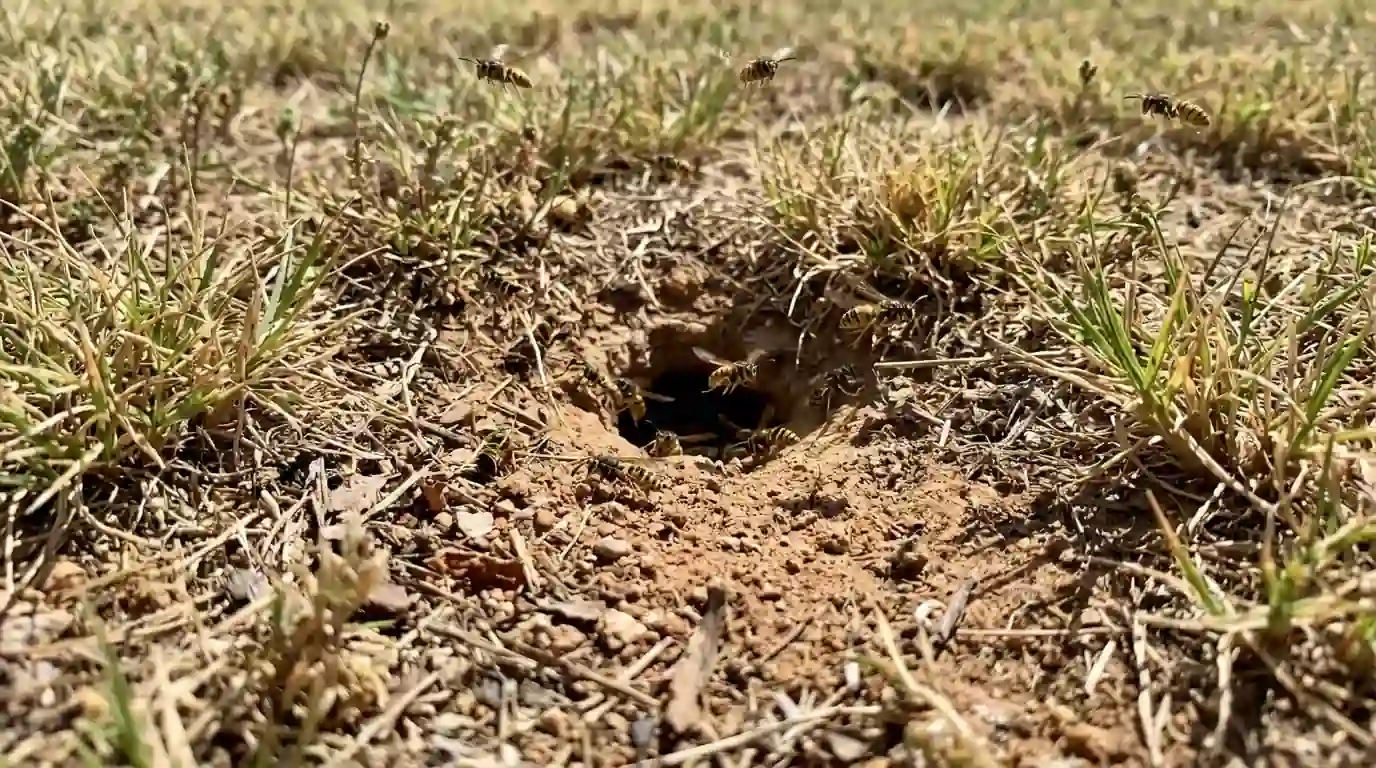
Yellowjackets flying in and out of a hole in the lawn, under a landscape timber or at the base of a shrub point to a ground nest.
Buzzing inside a wall
A buzzing or rustling sound inside a wall or ceiling, often with yellowjackets coming and going from a gap in siding or a weep hole.
Wasps indoors in late summer
Yellowjackets showing up inside the house can mean a wall-void colony has chewed through drywall or found a route inside.
Mud tubes in the garage
Clusters of mud tubes on garage walls, in the corners of a porch ceiling or on the side of a shed belong to mud daubers.
Yellowjackets around trash and food
Yellowjackets swarming outdoor trash cans, pet food and patio meals in late summer, when colonies are at their largest.
Why yellowjacket trouble peaks in Amarillo in late summer
Yellowjacket colonies start each spring with a single queen and grow all summer. By August and September they are at their largest, with hundreds or even thousands of workers, and they turn more defensive and more interested in sugary foods and meat. That is when most stings happen: at a backyard cookout, while mowing over a ground nest or when someone pulls a shrub that hides an entrance. Most yellowjacket nests here are in the ground, often in old rodent burrows, but some colonies build inside wall voids.
Paper wasps follow a similar calendar but build smaller, open nests. Amarillo's brick ranch homes give them plenty of sheltered spots under the eaves, behind shutters and inside the top of a porch column. The strong spring winds that make the Panhandle famous push wasps to build in the most sheltered corners, so nests often end up right above doors and windows where people pass.
The colonies die off as cold weather sets in, usually after the first hard freeze in late October. Only the new queens survive the winter, tucked into protected spaces, and they start new nests in spring. That makes April and May, right after the average last freeze around April 18, the easiest time to deal with paper wasps. A nest the size of a quarter with one queen on it is a far smaller problem than the same nest in August.
Need wasp & yellowjacket removal in Amarillo?
Call and tell us what you are seeing. The line is answered 24 hours a day, every day.
Why you should never seal a live nest inside a wall
When yellowjackets are flying in and out of a gap in the siding, a weep hole or a crack in the stucco, the first instinct is to plug the hole. Please do not. A colony inside a wall void can hold thousands of yellowjackets, and when their exit is blocked, they look for another way out. Often that new way out is through the drywall into a bedroom, a closet or the attic, and they can chew through drywall surprisingly fast. People end up with a room full of angry yellowjackets instead of a few outside.
The right approach is to treat the colony through its existing entrance. Our technician puts an insecticidal dust or foam into the opening, where returning workers carry it into the nest. Once activity has stopped for several days, the entrance can be sealed. If the nest is large, we may recommend opening the wall afterward to remove the comb, which otherwise can draw other insects or cause odors as it decays.
How our technician removes wasp and yellowjacket nests
Every job starts with confirming exactly what we are dealing with, because the method depends on it.
Identify and locate
We confirm whether you have paper wasps, yellowjackets, mud daubers or bees, then find every nest entrance. If it is a honey bee colony, that becomes a different job, covered on our bee removal page.
Treat at the right time
Where possible, we treat when most of the colony is inside, which is often early morning or toward dusk. Our technician wears protective gear and works with products labeled for stinging insects.
Handle eave and porch nests
Paper wasp nests under eaves and porch ceilings are treated, then scraped down and removed. We also treat the spot so new queens are less likely to rebuild there.
Dust ground and wall nests
Yellowjacket ground nests and wall voids get an insecticidal dust or foam placed into the entrance, so workers carry it inside. The opening stays open until activity stops.
Follow up and seal
We check that activity has stopped, then recommend sealing the entrance. For large wall nests, we may suggest removing the comb.
Staying safe around a nest until it is treated
A few precautions keep everyone safe until the nest is treated.
- Keep kids and pets away from the nest area, and mark ground nests so no one mows over them.
- Do not spray a store product into a wall void or ground nest; it often just stirs the colony up.
- Do not plug or caulk the entrance to a wall nest.
- Cover outdoor food and drinks and keep trash can lids closed in late summer.
- Check grills, mailboxes and patio umbrellas for paper wasp nests before using them.
- If someone is stung and has trouble breathing or swelling of the face or throat, call 911.
What changes the cost of wasp and yellowjacket removal in Amarillo
Stinging insect jobs are priced by the nest, its location and the work needed to reach it.
- Species
- Paper wasp nests under an eave are usually quicker than a large yellowjacket colony inside a wall.
- Nest location and height
- Nests on second-story eaves, inside walls or in hard-to-reach spots take more time and equipment.
- Number of nests
- Several paper wasp nests around a house add to the job compared with a single nest.
- Comb removal
- Opening a wall to remove a large yellowjacket nest is extra work beyond the treatment.
We quote after an inspection, or over the phone once we know what you are seeing and where the nest is.
Product lines a technician may choose from, matched to the pest, the room and who lives there:
Where we handle wasp & yellowjacket removal
Neighborhoods and towns we cover most often, with ZIP codes. The rest of Amarillo and the towns in our service area are covered too.
- City View79118
- Puckett79109
- Ridgecrest79109
- Sleepy Hollow79121
- Hollywood-Scotsman79110
- Windsor79109
- Belmar79106
- The Greenways79119
- Heritage Hills79119
- South Georgia Place79110
- Wolflin79109
- Eastridge79107
- Canyon79015
- Hereford79045
- Pampa79065
- Dumas79029
- Borger79007
- Bushland79012
Wasp & Yellowjacket Removal questions from Amarillo homeowners
Why are yellowjackets so aggressive around Amarillo homes in August and September?
Colonies are at their largest then, with hundreds or thousands of workers defending the nest. Late in the season they also hunt for sugary foods and protein, which brings them to cookouts, trash cans and pet food. Mowing near a ground nest sets them off quickly. That is why late summer is when most yellowjacket stings happen here.
Should I plug the hole where yellowjackets are going into my wall?
No. Sealing a live nest can force thousands of yellowjackets to chew through drywall into your living space. The colony should be treated through its existing entrance with a dust or foam, and the hole sealed only after activity has stopped for several days. Our technician handles that sequence for you.
Do mud daubers around my Amarillo garage need to be removed?
Usually it is optional. Mud daubers rarely sting and are solitary, so each mud tube is one wasp's nest rather than a colony. Many people just scrape the tubes off garage walls and porch ceilings. If there are many of them, we can treat the spots where they build to discourage new nests.
Will paper wasps rebuild in the same spot under my eaves?
They often try, because the same sheltered spot appeals to the next year's queens. After removing a nest, our technician treats the area to make it less inviting. Knocking down small new nests in early spring, when only a single queen is building, keeps a spot from becoming a problem again.