Pocket gopher control for Amarillo lawns and pastures
Fresh fan-shaped dirt mounds popping up across a lawn or along a pasture edge usually mean a pocket gopher working underground.We find its main tunnel and trap it there, where the gopher actually lives.
How do you get rid of pocket gophers in an Amarillo yard?
The most reliable way to get rid of a pocket gopher is trapping in its main tunnel. Our technician reads the fresh mounds to find the plugged lateral, probes for the main runway beside it, sets traps in both directions and covers the opening. We check the traps on a return visit and flatten mounds so any new digging shows up right away.
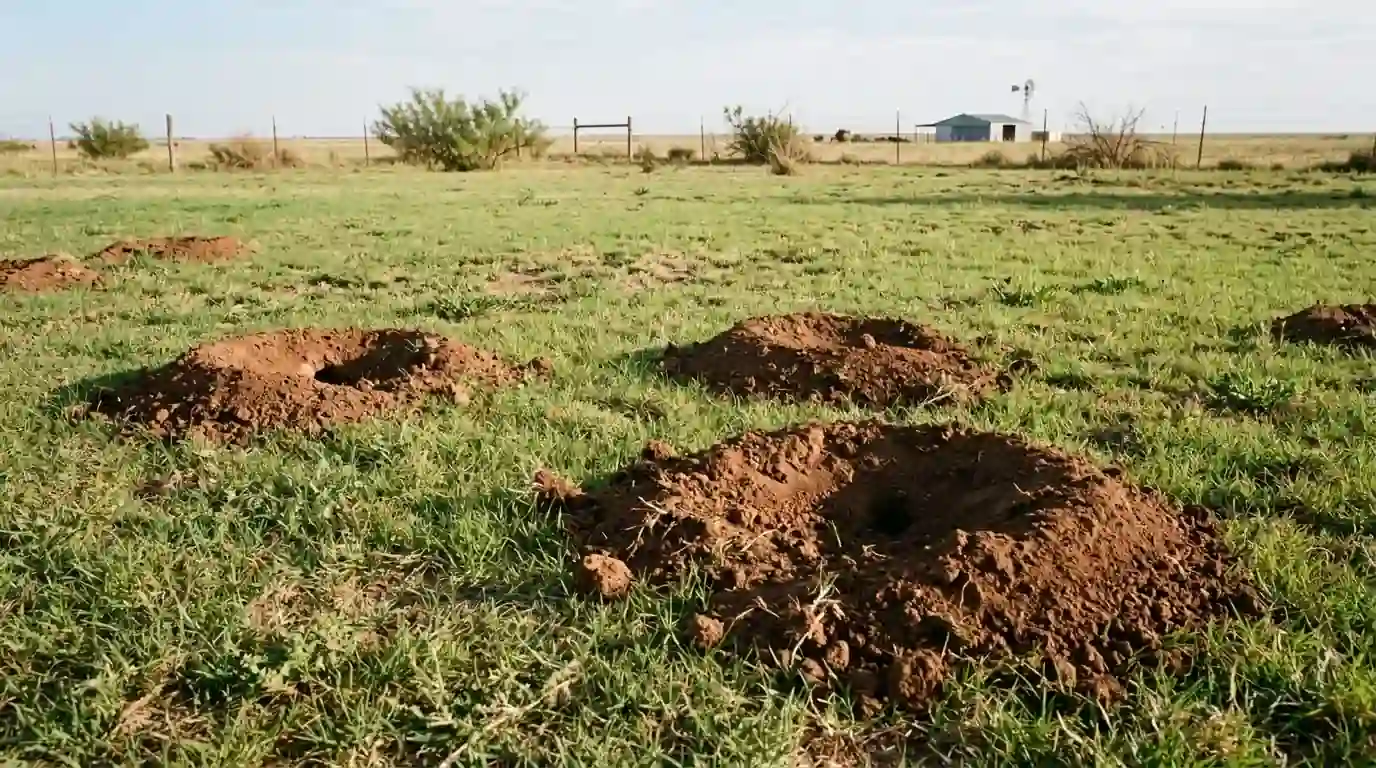
How to tell a pocket gopher from other diggers
Pocket gophers almost never show themselves, so the mounds are the main clue.
Fan or crescent mounds
Loose soil pushed into a fan or kidney shape, with a plugged hole off to one side, not in the center like an ant mound.
No open hole
Gophers seal their tunnels with a soil plug. Open, visible holes with clipped grass around them usually point to prairie dogs or ground squirrels instead.
Mounds in a line
New mounds appear every few feet in a rough line as the gopher extends its tunnel toward food.
Plants pulled down from below
A tomato plant, iris clump or young shrub that wilts or disappears into the ground in a day.
Soft spots underfoot
Sunken strips in the lawn where tunnels run close to the surface, especially after watering.
Chewed sprinkler lines
Drip tubing and irrigation lines gnawed underground, often found when a zone suddenly loses pressure.
Pocket gophers in Panhandle soils
Texas Tech's mammal records place the yellow-faced pocket gopher in the Panhandle in firmer soils, while Geomys pocket gophers use the deeper sands. Around Amarillo that means gophers turn up in irrigated lawns, garden beds, pasture edges, road ditches and the open ground on the south and southwest edge where new subdivisions meet old fields. Watered yards next to dry pasture are a favorite, because the turf and garden roots are softer and richer than anything outside the fence.
The heavy clay soil common here holds water after a storm, and gophers often push up a burst of fresh mounds after spring and summer rains, when the ground is easy to dig. Most of Amarillo's yearly rain falls from April to September, so that is when we see the most mound building. Gophers stay active all year underground, though, and a warm winter week can bring new mounds in January.
Why surface baiting and home remedies usually fail
Pocket gophers spend nearly their whole lives in sealed tunnels and come to the surface only briefly to push out dirt. Bait scattered on top of the lawn rarely reaches them, and it puts bait where pets, kids and birds can find it. Dropping poison pellets into a mound hole often misses too, because the mound sits on a short side tunnel that the gopher has already plugged and abandoned.
Flooding a tunnel mostly soaks the yard; the gopher plugs the flooded section and moves on. Smoke bombs leak out through cracks in the soil. Vibrating stakes and noisemakers may push a gopher a few yards, but it keeps feeding nearby. Gum, castor oil and similar remedies rarely do anything measurable. What works is getting a trap or treatment into the main runway, which is where a trained eye and a probe make the difference.
Need pocket gopher control in Amarillo?
Call and tell us what you are seeing. The line is answered 24 hours a day, every day.
How our technician traps a pocket gopher
Gopher trapping is about reading the ground, and these are the steps we follow.
Find the freshest mounds
We look for mounds with dark, moist soil and a visible plug, since those sit on tunnels the gopher is using now. Older dry mounds get flattened so we can see new activity.
Probe for the main runway
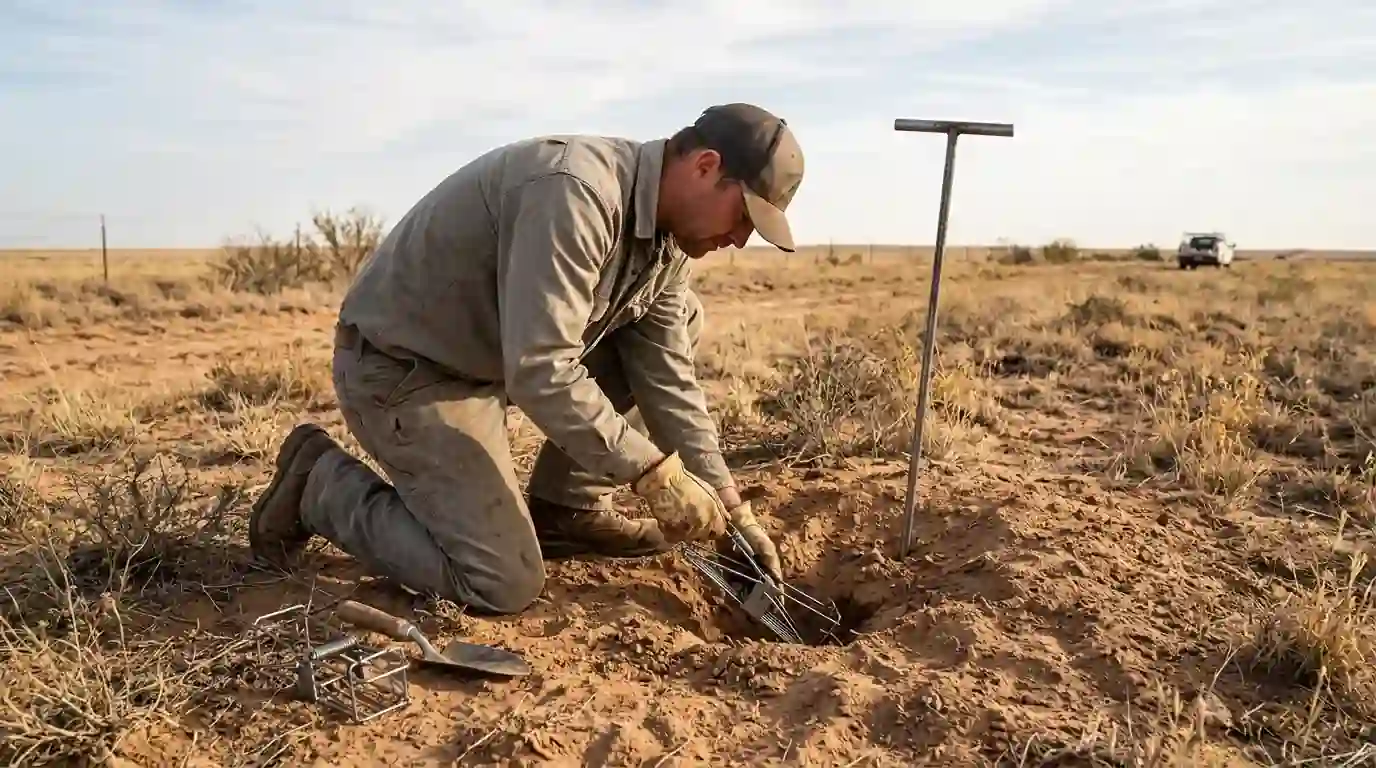
Using a metal probe, our technician pushes into the soil 8 to 12 inches from the plug side of the mound until it drops into the open tunnel. The main runway usually runs a few inches to a foot or more below the surface.
Open the tunnel and set traps
We dig down to the runway and set a pair of traps facing both directions, since we cannot know which way the gopher will come. Traps are staked so they cannot be pulled into the tunnel.
Cover and block light
The hole is covered with a board, sod or a bucket so light and air do not tip off the gopher. Gophers will plug any tunnel that lets in light.
Check and reset
On a return visit we check the traps and reset any that were plugged or sprung. A single gopher often controls a large area, so one catch can stop most of the mounds.
Watch for new mounds
After flattening the old mounds, any new one tells us whether another gopher is moving in from neighboring ground.
How to help us catch the gopher faster
A little help from you makes trapping faster and shows us where the gopher is working.
- Rake or flatten old mounds so fresh ones are easy to spot the next morning.
- Mark new mounds with a flag or stick and tell our technician where they appeared.
- Leave covered trap sites alone and keep dogs from digging at them.
- Plant new shrubs and bulbs inside wire mesh baskets in gopher-prone beds.
- Lay hardware cloth under raised garden beds before filling them with soil.
- Keep the strip along the fence mowed short so new mounds from the pasture side are visible.
Pocket gopher or something else?
Different diggers leave different marks, and the right fix depends on knowing which one you have.
| What you see | Likely animal | What it means |
|---|---|---|
| Fan-shaped mound, plugged hole to one side | Pocket gopher | Trapping in the main tunnel |
| Large mounds with open holes, clipped grass, barking | Prairie dog | Colony inspection, owl and plague checks |
| Small cone-shaped holes in turf | Skunk or raccoon digging for grubs | Check the lawn for white grubs |
| Fist-size hole under a slab or shed edge | Norway rat or skunk den | Burrow inspection near the structure |
| Raised ridges with no mounds | Shallow tunneling near the surface | Inspection to identify the digger |
What changes the cost of pocket gopher control in Amarillo
Gopher jobs are priced on the area involved and how many animals are working it.
- Number of gophers
- Most yards have one or two, but pasture edges next to open land can hold several.
- Area to cover
- A single lawn is quicker than a lawn, garden and several acres of pasture edge.
- Soil conditions
- Very dry, hard soil makes probing and digging slower, while moist soil after rain helps.
- Number of return visits
- Each trap check is a visit, and gophers that dodge traps can take a few rounds.
- Pressure from neighboring land
- Gophers moving in from adjacent pasture may mean ongoing monitoring.
We quote by phone once we know the size of the area and how many fresh mounds you see, or after a quick look on site.
Product lines a technician may choose from, matched to the pest, the room and who lives there:
Where we handle pocket gopher control
Neighborhoods and towns we cover most often, with ZIP codes. The rest of Amarillo and the towns in our service area are covered too.
- City View79118
- Puckett79109
- Ridgecrest79109
- Sleepy Hollow79121
- Hollywood-Scotsman79110
- Windsor79109
- Belmar79106
- The Greenways79119
- Heritage Hills79119
- South Georgia Place79110
- Wolflin79109
- Eastridge79107
- Canyon79015
- Hereford79045
- Pampa79065
- Dumas79029
- Borger79007
- Bushland79012
Pocket Gopher Control questions from Amarillo homeowners
How many pocket gophers are in my Amarillo yard?
Usually fewer than people think. Pocket gophers live alone, except during breeding season and while young are in the nest, and one gopher can push up dozens of mounds across a yard. Most residential lawns have one or two. A sudden spread of mounds along a pasture fence may mean more are moving in from open land next door.
Will pocket gophers damage my sprinkler system?
They can. Pocket gophers gnaw on drip tubing, irrigation lines and sometimes buried wiring as they tunnel. A zone that suddenly loses pressure or a wet spot in the lawn near fresh mounds is a common sign. Trapping the gopher stops further damage, and running new lines inside conduit or hardware cloth helps in gopher-prone beds.
Why do pocket gopher mounds appear after rain in Amarillo?
Rain softens the heavy clay soil, so pocket gophers dig faster and push up more dirt. Most of Amarillo's rain falls from April to September, which is when mound building peaks. Fresh mounds after a storm are a good time to call, since moist soil also makes it easier for our technician to probe and set traps.
Can pocket gophers be poisoned instead of trapped?
Below-ground baits can work when they are placed directly into the main tunnel, but surface baiting or dropping bait into mound holes usually misses and can expose pets and wildlife. For most Amarillo yards, trapping in the main runway gives a clearer result: you know when the pocket gopher is caught, and no bait sits on the surface where a dog could find it.