Pre-construction termite treatment for Amarillo builds
The easiest time to protect a house from termites is before the slab is poured, while the soil is still open.We treat the prepared building pad for Amarillo-area builders and owner-builders, timed to the pour, so termite protection is in the ground from day one.
When should pre-construction termite treatment be done on a new Amarillo home?
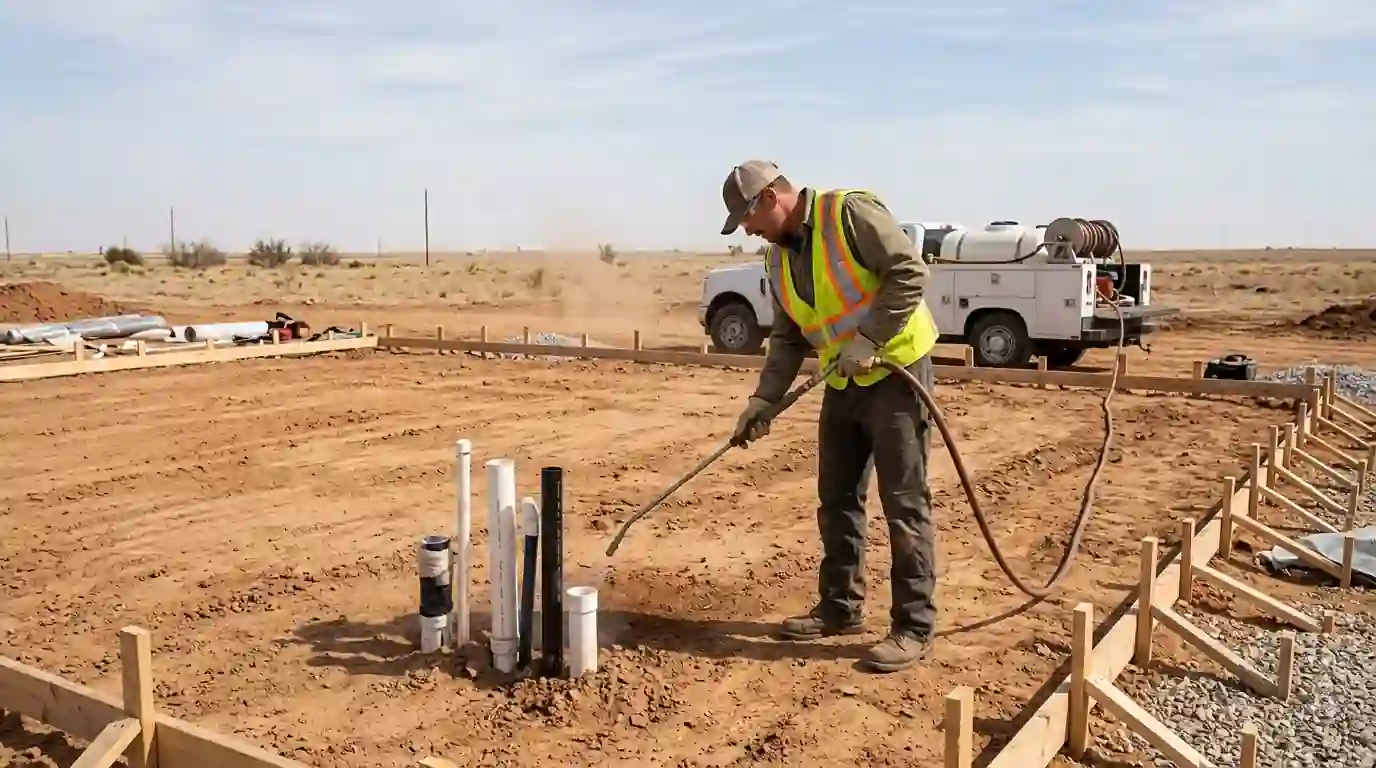
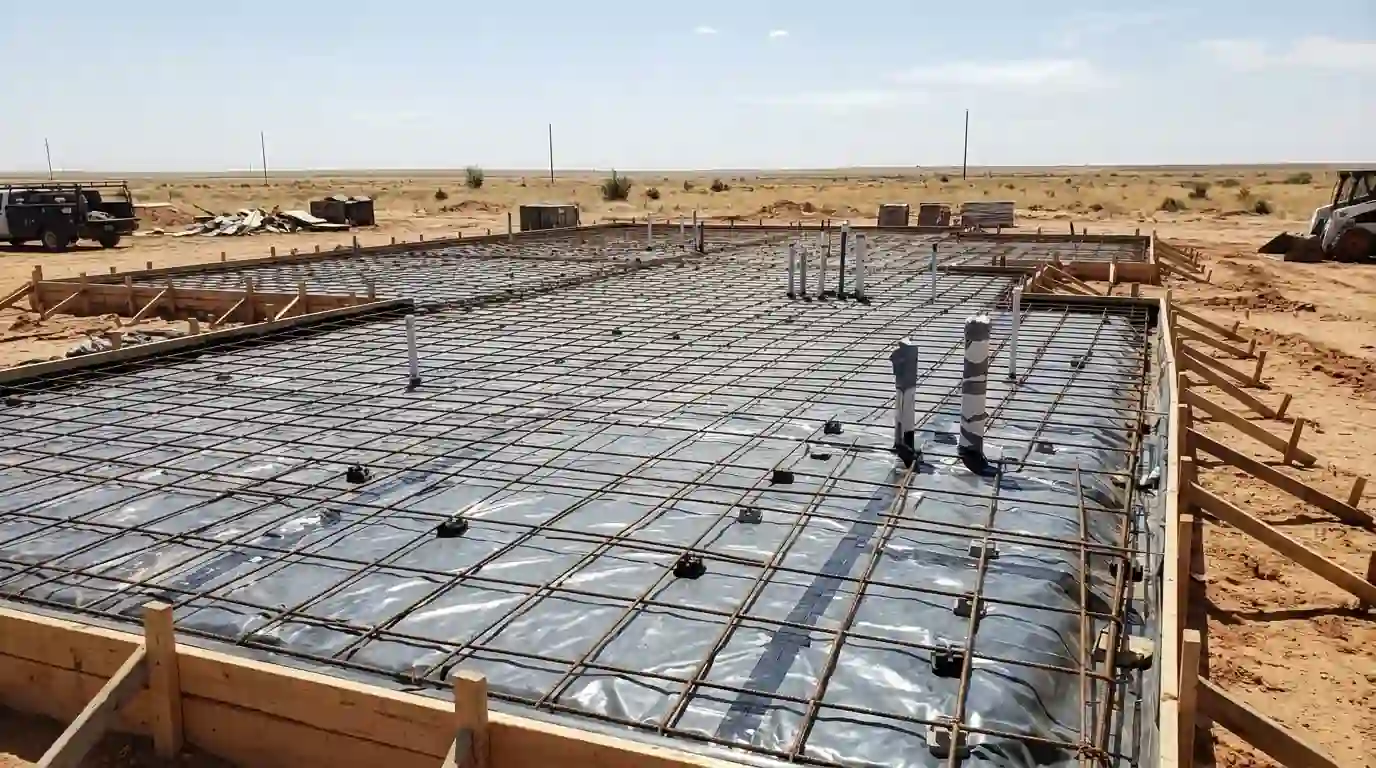
Pre-construction termite treatment on a new Amarillo home is done after the building pad is graded, compacted and the under-slab plumbing is in, but before the plastic sheeting is laid and the concrete is poured. The technician treats the soil inside the forms, around plumbing penetrations and along footings. A second treatment along the outside of the foundation follows after final grading.
Why treat the soil before the slab goes in
Once a slab is poured, the soil underneath is sealed off for good. Treating it later means trenching around the outside and drilling through concrete. Before the pour, the technician can reach every square foot of the pad, the soil around each plumbing riser and the trenches where footings sit. That is where native subterranean termites most often find their way into a slab home: through gaps around pipes and along edges where the slab meets the footing.
Pre-construction treatment puts a treated layer of soil under and around the house before anything covers it. It does not replace good building practice like keeping wood off the soil and grading water away. But it gives the house protection that would cost more and take more work to add after the family moves in.
How a pre-construction treatment fits the build schedule
Timing is everything on a new build, so we work from the builder's schedule.
Get the call when the pad is ready
The builder or owner-builder calls once the pad is graded and compacted and the under-slab plumbing is set. We confirm the pour date so treatment happens close to it, not weeks ahead.
Check the pad before treating
The technician walks the pad to confirm it is ready: forms set, plumbing in, no standing water, no scrap wood or form boards buried in the fill.
Treat the soil under the slab
A termiticide is applied evenly across the soil inside the forms at the label rate. Extra attention goes to plumbing risers, utility penetrations and anywhere the slab will have a joint.
Treat footings and edges
Footing trenches and the inside edge of the forms are treated, since the joint between footing and slab is a common entry point.
Leave a treatment record
The builder gets a written record of the date, area treated and product used. That record stays with the house and is useful when it is sold.
Come back after final grade
Once landscaping and final grade are done, the outside of the foundation is treated so soil placed against the house is covered too.
New construction around Amarillo and Canyon
Much of Amarillo's new building is on the south and southwest sides. City View has been building Craftsman homes since the 2000s and is still going. Heritage Hills is filling in with new Craftsman and brick-and-stone homes, and Tradewind Square on the southeast side saw most of its homes built between 2017 and 2020. Between Canyon and south Amarillo, subdivisions keep growing along I-27. Nearly all of these homes are built on slabs.
Native subterranean termites live in soil throughout the Panhandle, including former pasture and wheat ground being turned into new lots. Clearing land disturbs colonies, but it does not remove them, and they forage into the new pad looking for wood. Scrap lumber and form boards buried in fill give them a head start, which is why we check the pad before treating.
Weather affects timing. Amarillo's rain, most of it from April to September, often arrives as heavy thunderstorms, and clay soil hangs on to it. Treating a saturated pad is not effective, so after a storm we may wait for the soil to dry before treating. Spring winds can also scour a pad, so we coordinate closely with the builder on the final days before the pour.
Need pre-construction termite treatment in Amarillo?
Call and tell us what you are seeing. The line is answered 24 hours a day, every day.
Common pre-pour problems we find on building pads
These issues are easiest to fix before the vapor barrier goes down.
Wood buried in the fill
Form boards, stakes and scrap lumber left in the pad become termite food under the house.
Standing water on the pad
Water pooled after a storm keeps treatment from soaking evenly into the soil.
Plumbing not finished
If risers are added after treatment, the soil disturbed around them is no longer treated.
Pad already covered
If the vapor barrier is already laid, treatment has to wait until it can be pulled back or the plan changes.
Pour date moved
A delay of several weeks after treatment, especially with rain or traffic on the pad, may mean parts need retreating.
Grade sloping toward the house
A final grade that drains toward the slab keeps soil wet where termites enter later.
What builders and owner-builders can do
These steps help the treatment do its job for the life of the house.
- Call us as soon as you know the pour date, and again if it moves.
- Pull form boards, stakes and scrap wood out of the pad before treatment.
- Have all under-slab plumbing and conduit in place before we treat.
- Keep foot traffic and equipment off the treated pad until the vapor barrier goes down.
- Leave several inches of exposed slab above final grade, without brick ledges buried in soil.
- Plan gutters and AC condensate lines to drain away from the foundation.
- Keep the treatment record with the closing papers for the homeowner.
What changes the cost of pre-construction termite treatment in Amarillo
Pre-construction work is priced by the size of the slab and the scope of the job.
- Slab square footage
- Larger pads take more product and time. Attached garages and covered patios add area.
- Footings and penetrations
- More plumbing risers and longer footing runs mean more targeted work.
- Final grade treatment
- Including the exterior treatment after final grading adds a second visit.
- Distance from Amarillo
- Builds out toward Canyon, Bushland or rural acreage may affect scheduling.
- Number of homes
- Builders with several homes in one subdivision can often schedule them together.
We quote pre-construction treatment by phone once we know the slab size and the location of the build.
Product lines a technician may choose from, matched to the pest, the room and who lives there:
Where we handle pre-construction termite treatment
Neighborhoods and towns we cover most often, with ZIP codes. The rest of Amarillo and the towns in our service area are covered too.
- City View79118
- Puckett79109
- Ridgecrest79109
- Sleepy Hollow79121
- Hollywood-Scotsman79110
- Windsor79109
- Belmar79106
- The Greenways79119
- Heritage Hills79119
- South Georgia Place79110
- Wolflin79109
- Eastridge79107
- Canyon79015
- Hereford79045
- Pampa79065
- Dumas79029
- Borger79007
- Bushland79012
Pre-Construction Termite Treatment questions from Amarillo homeowners
Can termite treatment be done after the slab is poured on a new Amarillo home?
Yes, but it takes more work. After the pour, the soil underneath can only be reached by trenching along the outside and drilling through concrete at patios and the garage. Bait stations around the perimeter are another post-construction option. Treating the open pad before the pour is simpler and reaches the soil under the whole slab, which is why builders schedule it.
What if it rains after pre-construction termite treatment in Amarillo?
A light rain after the soil has absorbed the treatment is usually not a problem. Heavy rain right after treatment, or water standing on the pad, can move product around, so we may check the pad before the pour. If storms are forecast, we try to treat after they pass and when the soil can absorb it, which is common during the spring and summer thunderstorm season.
Do owner-builders in Canyon and Amarillo need pre-construction termite treatment?
It is a choice for owner-builders, but it is one of the simplest protections to add while the pad is open. Native subterranean termites live throughout the Panhandle, including the farmland and pasture where new homes go up. If your lender or buyer later asks about termite protection, a treatment record from construction answers that question.
How close to the pour should pre-construction termite treatment happen?
As close as practical, ideally a day or two before the plastic sheeting goes down and the concrete trucks arrive. Treating weeks ahead leaves time for rain, wind and crew traffic to disturb the soil. Call when you have the pour date and again if it moves, and we will schedule the treatment around it.