Skunk removal from under Amarillo porches and decks
A skunk denning under your porch, deck or shed brings odor, holes and a rabies concern for pets.We remove the skunk, close the den so another one cannot move in, and explain the timing around spring young. We answer 24/7.
How do you get a skunk out from under a porch or shed in Amarillo?
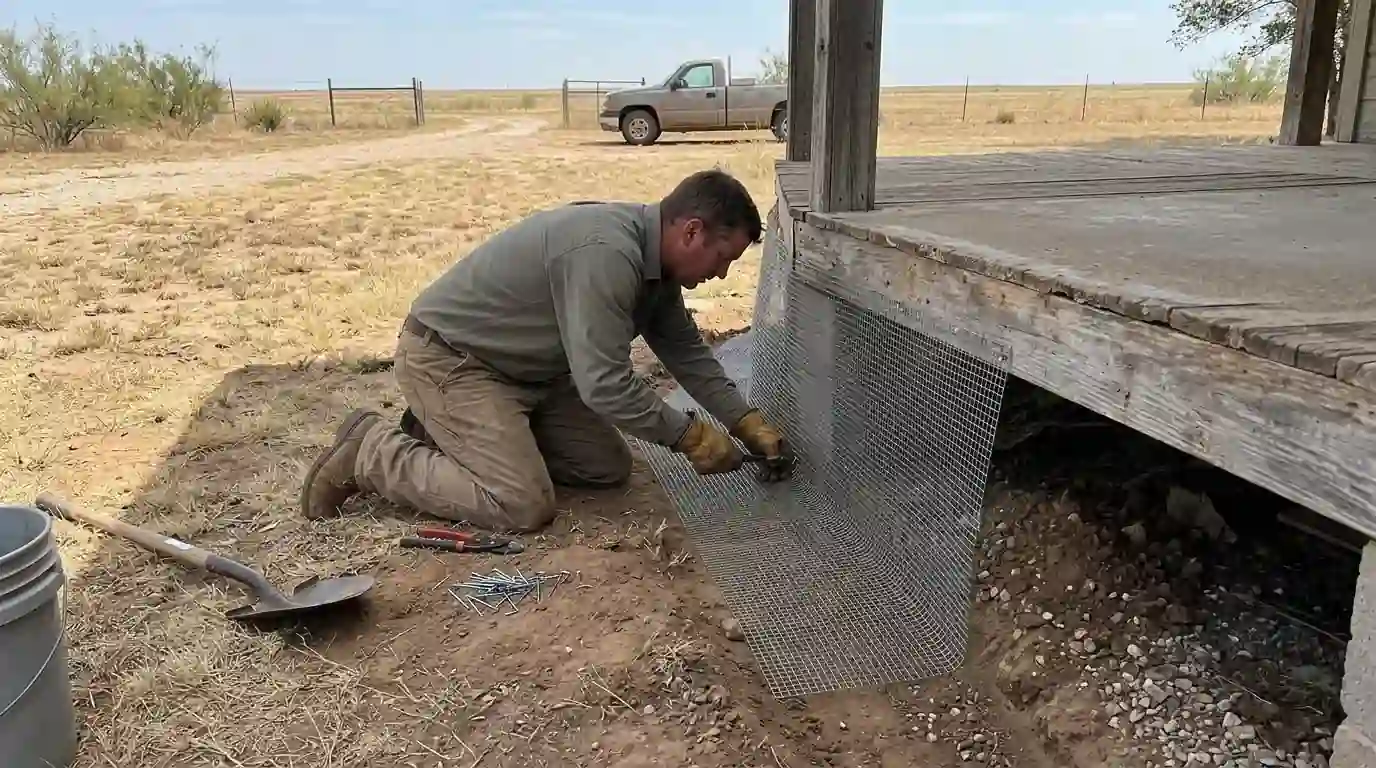
To get a skunk out from under a porch or shed, the den has to be confirmed, the skunk removed or encouraged out, and the opening closed for good. Our technician checks for young, removes the skunk by trapping or a one-way exit depending on the season, then buries an L-shaped wire barrier along the open sides so no new skunk can dig back in.
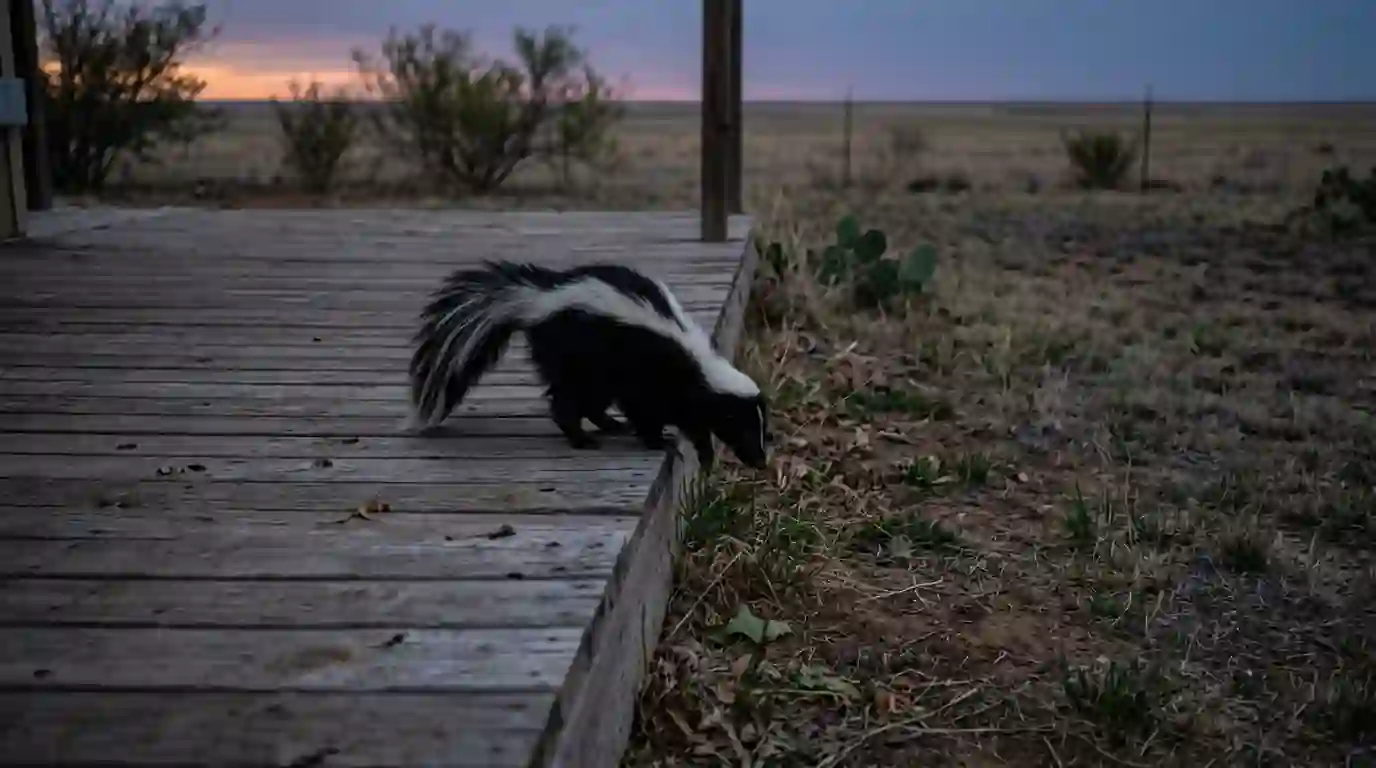
Signs a skunk is living under your house or deck
Skunks are active at night, so most people notice the clues before they see the animal.
Odor that comes and goes
A musky smell near a porch, deck or crawlspace vent, often strongest at night or when a dog gets close to the opening.
A smooth hole at the edge
A 4 to 6 inch opening dug under a slab edge, porch step, deck skirt or shed floor, with packed dirt worn smooth by use.
Small cone-shaped holes in the lawn
Neat divots about the size of a fist where skunks dig for grubs and beetles, usually overnight.
Tracks in soft soil
Five-toed prints with visible claw marks near the den entrance or a flower bed.
Dog reactions at night
A dog that fixates on one corner of the porch or comes back sprayed is often the first real sign.
Spilled trash and pet food
Knocked-over cans and empty pet bowls in the garage or patio, since skunks feed on easy food.
Skunks and rabies around Amarillo
Striped skunks live across Texas and often den under houses, decks and outbuildings. They are one of the main animals tracked for rabies in the state. Texas recorded 118 rabid skunks in 2025, and Texas DSHS reported two of them in Randall County in December 2025. In 2019, local news reported three rabid skunks found in Vega, west of Amarillo on I-40. Those numbers are a reminder to keep pets vaccinated and never handle a skunk, alive or dead.
A skunk that wanders in daylight, seems unafraid of people, walks in circles or acts paralyzed may be sick. Keep everyone back and call animal control or the health department about a skunk acting that way. If a pet tangles with a skunk, call your veterinarian about a rabies booster even if the animal looks healthy.
Amarillo homes give skunks plenty of den choices: porch slabs with hollow fill, decks built close to the ground, storage sheds on blocks and pier-and-beam crawlspaces in older neighborhoods. Lots that back onto pasture, draws or vacant ground see the most visits.
Why spring timing matters for skunk removal
Striped skunks breed in February and March, and young are born in May. A female looking for a nursery den in early spring is exactly the skunk that moves under a porch. If she is excluded or trapped in May or June, her kits can be left under the slab, where they starve and create a much worse odor problem.
That is why our technician asks when you first noticed the skunk and checks for signs of young before closing any opening. In late spring, the plan may be to wait until the young are moving with their mother, then use a one-way exit and seal the den once the family has left. Outside the nursery season, removal can usually move faster.
Fall brings a second busy stretch. Young skunks born in May leave their mothers by late summer and look for dens of their own, and cooler nights after the first freeze in late October send them under porches and sheds for winter. Skunks do not truly hibernate, but they slow down and share dens in cold snaps, so a single hole can shelter more than one animal by December. Sealing open sides of decks and sheds in early fall heads off that problem before it starts.
Need skunk removal in Amarillo?
Call and tell us what you are seeing. The line is answered 24 hours a day, every day.
What happens on a skunk removal visit
Our technician works calmly and slowly around skunks, because a startled skunk sprays.
Confirm the den is active
We check the opening for tracks, fresh digging and odor. Sometimes we loosely block the hole with crumpled paper or soil overnight to see if it is pushed open.
Check for young
During the spring nursery season we look and listen for kits before choosing a method, so no young are sealed in.
Remove the skunk
Depending on the situation, we trap the skunk with a covered trap that keeps it calm or fit a one-way door that lets it leave and not return. We explain which method fits and why.
Handle it under TPWD rules
Texas Parks and Wildlife allows landowners and their agents to take nuisance furbearers like skunks on their property. Releasing a skunk somewhere else requires TPWD authorization and the consent of that landowner, so we follow those rules on every job.
Seal the den for good
We bury an L-shaped barrier of welded wire or hardware cloth along the open sides of the porch, deck or shed, about a foot down and bent outward, so a skunk that digs hits wire.
Deal with odor and grubs
We point out spray spots that need cleaning and check whether lawn grubs are drawing skunks back to dig.
How to keep skunks from coming back
Skunks return to easy food and easy shelter, so take both away.
- Feed pets indoors or pick up bowls before dark.
- Keep trash cans lidded and stored in the garage until pickup day.
- Pick up fallen fruit and spilled birdseed under feeders.
- Close gaps under decks, porches and sheds with buried wire, not loose lattice.
- Turn on a porch light or let your dog out on a leash after dark during spring.
- Keep pets current on rabies vaccines and never let them near a skunk den.
- Treat lawn grubs if skunks keep digging small holes in the turf.
What changes the cost of skunk removal in Amarillo
Skunk jobs vary with the den location, the season and how much sealing is needed.
- Den location
- A shed on blocks is simpler to seal than a long porch slab or a crawlspace with several vents.
- Season and young
- Nursery season can mean waiting for kits to move, which adds visits.
- Removal method
- Trapping requires daily checks, while one-way exits need a follow-up to confirm the skunk left.
- Length of barrier
- Burying wire along a whole deck perimeter takes more material and labor than closing one hole.
- Multiple skunks
- More than one skunk, or more than one den on the property, adds trapping time.
We quote after a look at the den, or by phone once we know where the skunk is living.
Product lines a technician may choose from, matched to the pest, the room and who lives there:
Where we handle skunk removal
Neighborhoods and towns we cover most often, with ZIP codes. The rest of Amarillo and the towns in our service area are covered too.
- City View79118
- Puckett79109
- Ridgecrest79109
- Sleepy Hollow79121
- Hollywood-Scotsman79110
- Windsor79109
- Belmar79106
- The Greenways79119
- Heritage Hills79119
- South Georgia Place79110
- Wolflin79109
- Eastridge79107
- Canyon79015
- Hereford79045
- Pampa79065
- Dumas79029
- Borger79007
- Bushland79012
Skunk Removal questions from Amarillo homeowners
Should I worry about rabies from a skunk under my Amarillo porch?
Take it seriously but don't panic. Skunks are a common rabies carrier in Texas, and two rabid skunks were reported in Randall County in December 2025. Most denning skunks are healthy, but keep pets vaccinated and away from the den, and never handle a skunk. A skunk acting strangely in daylight should be reported to animal control.
Can you just relocate the skunk somewhere outside Amarillo?
Not without permission. Texas Parks and Wildlife allows landowners and their agents to take nuisance skunks on their own property, but releasing one elsewhere requires TPWD authorization plus the consent of the landowner where it is released. Our technician follows those rules and explains how the skunk will be handled before removal starts.
When do skunks have babies in the Panhandle?
Striped skunks breed in February and March and give birth in May. A mother skunk looks for a protected nursery den in spring, often under a porch or shed. Sealing a den in May or June can trap the kits inside, so our technician checks for young and times skunk removal around them.
Why are skunks digging small holes in my Amarillo lawn?
Those neat, fist-size holes usually mean skunks are digging for grubs, beetles and other insects in the turf. A lawn with a white grub problem can draw skunks night after night. Removing the denning skunk helps, and treating the grubs takes away the reason other skunks keep visiting.
Does lattice keep skunks out from under a deck?
Usually not. Skunks dig under lattice or push through thin panels easily. What works is an L-shaped barrier of welded wire or hardware cloth buried about a foot deep along the open sides and bent outward, so a digging skunk runs into wire. We install that barrier after skunk removal so the den stays closed.