Lawn grub control for Amarillo yards
Brown patches that peel back like loose carpet in midsummer often mean white grubs are eating the roots under your lawn.We confirm grubs are the cause, then time a treatment to hit the young larvae before the worst damage shows.
How do you know if your Amarillo lawn has grubs, and how do you treat them?
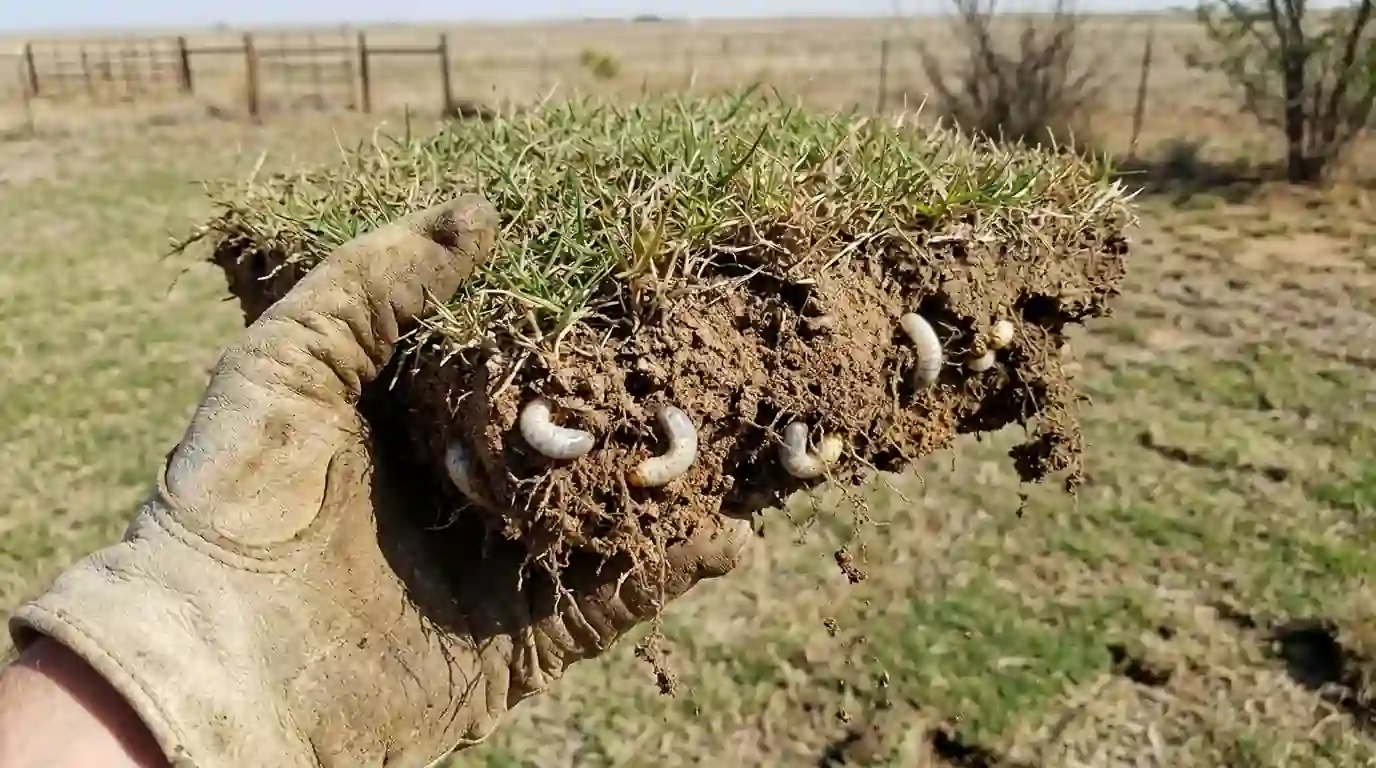
To check for grubs, cut a square foot of turf at the edge of a brown patch and peel it back; several C-shaped white larvae in that square suggest a treatment is worthwhile. Our technician confirms the count, rules out drought and disease, then applies a grub treatment timed to young larvae in early to midsummer, watered in so it reaches the root zone.
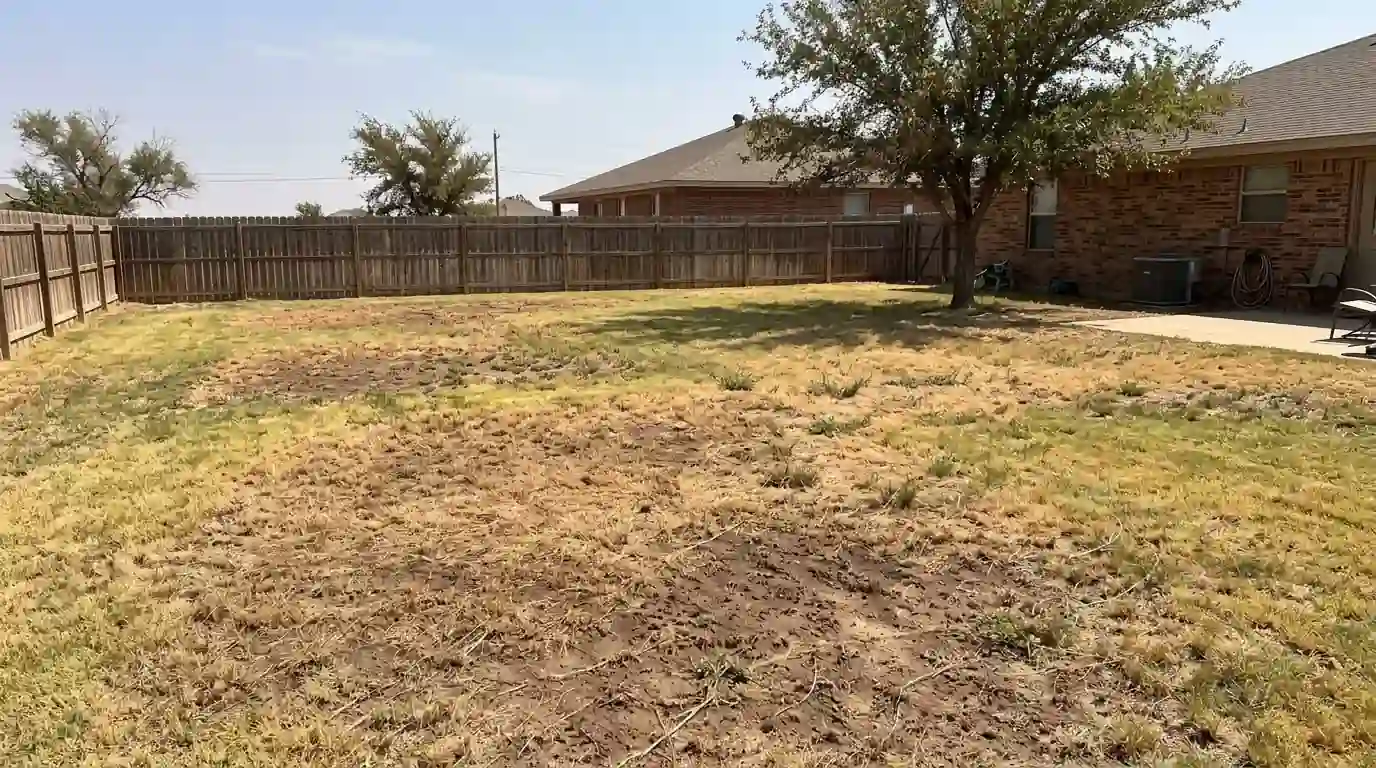
Signs white grubs are damaging your lawn
Grub damage can look like drought at first, so look for these specific clues.
Turf that lifts like carpet
Brown grass that rolls back easily in a mat with no roots holding it down, because grubs have eaten them.
Irregular brown patches
Dead or thinning patches that grow from June into fall, even where the sprinklers reach.
Spongy ground underfoot
Turf that feels soft and loose when you walk on it, as if it were sitting on top of the soil.
Skunks or birds digging
Small cone-shaped holes or torn-up turf overnight, as skunks, raccoons and birds dig for grubs.
Beetles at porch lights
Lots of brown June beetles or masked chafers buzzing around lights in late spring and summer evenings.
Patches that ignore watering
Extra water does not green up the area, which points away from simple drought stress.
The grubs under Panhandle lawns
White grubs are the larvae of several beetles, and Texas A&M AgriLife names June beetles and the southern masked chafer as the main ones in Texas lawns. The adults are the brown beetles that bump into porch lights and screen doors in late spring and summer. They lay eggs in turf, and the eggs hatch into small C-shaped grubs with cream-colored bodies and brown heads that feed on grass roots just below the surface.
The young grubs grow quickly through the summer, and that is when feeding causes the most visible damage. AgriLife notes lawn damage runs from June to October, coming later in cooler regions. By late fall the grubs move deeper in the soil to spend the winter, then come back up in spring to finish growing before turning into adults. Most of the damage you see comes from one summer's generation of larvae.
How to check your own lawn for grubs
A quick dig at the edge of a brown patch tells you whether grubs are the problem.
- Pick a spot where green grass meets the brown patch, since grubs feed at the active edge.
- Cut three sides of a square about one foot across, two to three inches deep, with a flat shovel.
- Fold the turf back like a page and look in the top few inches of soil.
- Count the C-shaped white grubs; a few is normal, but a higher count suggests treatment.
- Check two or three spots across the lawn to see how widespread they are.
- Press the turf back down and water it well so the grass recovers.
- If you find no grubs, the patch may be drought, sprinkler coverage or disease instead.
Need lawn grub control in Amarillo?
Call and tell us what you are seeing. The line is answered 24 hours a day, every day.
Grub timing in Amarillo's climate
Amarillo's average last spring freeze is around April 18, and June beetles and masked chafers start flying as warm nights settle in during late spring. Adults fly from late spring through summer, so eggs go into lawns over several weeks. That makes early to midsummer the best window for treatment, when most grubs have hatched but are still small and feeding near the surface.
About three quarters of Amarillo's yearly rain falls from April to September, much of it from thunderstorms. Watered lawns in a dry spell are where beetles prefer to lay eggs, since the soil stays moist. That is why irrigated yards in neighborhoods across south and west Amarillo often show grub damage while dry pasture next door does not. The heavy clay soil here also holds water near the surface, which suits grubs feeding in the top few inches.
Damage usually becomes obvious in July and August, when heat stress and root loss hit at the same time. Patches that show up in September and October may be the last of that year's feeding before grubs move deeper for winter.
What our technician does on a grub control visit
We confirm the cause before treating, since brown grass has many possible causes.
Inspect the brown patches
We look at the pattern of damage, check sprinkler coverage and look for signs of digging animals.
Dig and count
Our technician cuts sample squares at the edges of the damage and counts grubs to see whether the numbers justify treatment.
Rule out other causes
If grub counts are low, we point out other likely causes such as drought, a dry sprinkler zone or lawn disease, and skip a treatment that would not help.
Apply a timed treatment
When grubs are confirmed, we apply a grub treatment matched to the time of year, using products aimed at young larvae in early summer or at larger grubs later in the season.
Water it in
Grub treatments need water to move into the root zone. We tell you how much to water and when, and we explain re-entry times for kids and pets.
Recheck the lawn
We can return to check grub counts and whether the turf is rooting again.
Helping a grub-damaged lawn come back
Once grubs are under control, the grass still needs to regrow roots. Water deeply and less often rather than every day, so roots grow down into the soil instead of staying shallow. Rake out dead, matted turf from patches that have fully died, and overseed or patch with sod in the right season for your grass type.
Keep mowing at the higher end of the range for your grass, since taller grass shades the soil and supports deeper roots. If skunks or raccoons have been digging for grubs, that activity usually stops once the grubs are gone. Watching for beetles at the porch light next spring tells you whether a preventive treatment makes sense the following summer.
What changes the cost of grub control in Amarillo
Grub treatment is priced on the lawn and the timing.
- Lawn size
- Treatment is applied across the turf, so a larger yard takes more product and time.
- Preventive or curative
- An early-summer preventive treatment differs from a late-season treatment aimed at large grubs.
- Extent of damage
- A few patches can sometimes be spot treated, while lawn-wide damage needs a full application.
- Follow-up checks
- Return visits to recheck grub counts or treat again add to a single application.
We quote by phone once we know the lawn size and what you are seeing, or after inspecting the damage.
Product lines a technician may choose from, matched to the pest, the room and who lives there:
Where we handle lawn grub control
Neighborhoods and towns we cover most often, with ZIP codes. The rest of Amarillo and the towns in our service area are covered too.
- City View79118
- Puckett79109
- Ridgecrest79109
- Sleepy Hollow79121
- Hollywood-Scotsman79110
- Windsor79109
- Belmar79106
- The Greenways79119
- Heritage Hills79119
- South Georgia Place79110
- Wolflin79109
- Eastridge79107
- Canyon79015
- Hereford79045
- Pampa79065
- Dumas79029
- Borger79007
- Bushland79012
Lawn Grub Control questions from Amarillo homeowners
When should I treat for lawn grubs in Amarillo?
Early to midsummer is usually the best time to treat for grubs in Amarillo, after June beetles and masked chafers have laid eggs and the young larvae are small and feeding near the surface. Damage shows from June to October. Late-season treatments can still help when large grubs are found, but they work less well than catching grubs young.
How many grubs per square foot means my Amarillo lawn needs treatment?
A few grubs in a square foot are normal, and a healthy, well-watered lawn can handle them. When most of your sample squares hold clearly more than a few, and the grass above them is thinning or lifting, treatment is usually worthwhile. Our technician digs sample squares across your lawn to see whether grub numbers justify a treatment.
Why are skunks digging up my lawn for grubs?
Skunks, raccoons and birds dig through turf at night to eat white grubs, leaving small holes or torn patches. Digging is often the first sign of a grub problem. Controlling the grubs removes the food source, and the digging usually stops. If a skunk is also denning under your porch, skunk removal may be needed too.
Are June beetles and masked chafers the same as lawn grubs?
They are the adult form. June beetles and southern masked chafers are the brown beetles drawn to porch lights in late spring and summer. They lay eggs in lawns, and the larvae that hatch are the C-shaped white grubs that eat grass roots. Lots of beetles at your lights can be an early warning for grub damage later.