Carpet beetle control for Amarillo closets and rugs
Bald patches in a wool rug, holes in a stored sweater or bristly larvae under the bed point to carpet beetles feeding somewhere quiet.We trace them to what they are eating, often dead insects or an old nest, and treat the source. We answer 24/7.
How do you get rid of carpet beetles in an Amarillo house?
You get rid of carpet beetles by finding and removing what the larvae are eating, then treating the cracks and fabrics around it. Our technician checks closets, rugs, light fixtures, window sills and the attic for dead insects, lint and old bird nests, then treats baseboards, carpet edges and closet floors. You vacuum hard and launder or freeze affected clothing.
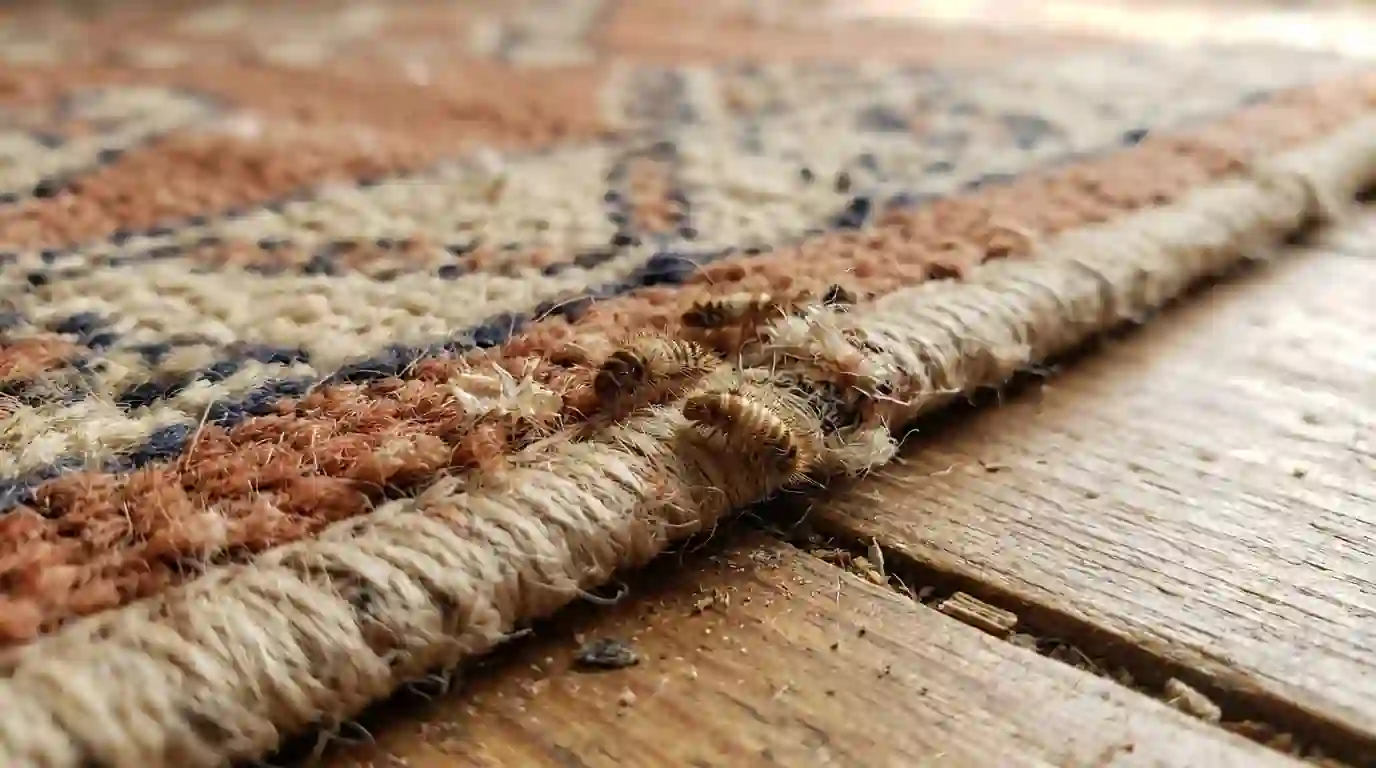
Signs of carpet beetles in closets, rugs and windows
Adults are easy to miss, so most people find the larvae or the damage first.
Fuzzy, bristly larvae
Carpet beetle larvae are small, carrot-shaped and covered in brown bristles. They crawl slowly along baseboards, under furniture and inside drawers.
Shed skins in corners
Larvae molt several times, leaving empty brown husks that look like tiny dead caterpillars in closet corners, along carpet edges and under beds.
Holes in wool and silk
Irregular holes in sweaters, wool blankets, felt hats and silk scarves, especially along folds and seams where they sat undisturbed.
Bare patches on rugs
Worn spots on wool rugs, often under a couch or bed where nobody vacuums, with the backing showing through in places.
Tiny round beetles on sills
Adults are about the size of a pinhead, round and mottled, and they fly toward windows on bright days in spring and early summer.
Larvae near light fixtures
Larvae crawling on the ceiling or dropping from a light fixture usually means dead insects are piled inside the glass cover.
Dead miller moths and carpet beetles in Panhandle homes
The Panhandle has a carpet beetle food source that most of the country does not. Every spring, from late April through May, miller moths come through Amarillo by the thousands on their way northwest to Colorado. They squeeze into attics, garages, wall voids and the space around window frames, and a lot of them die there. Colorado State researchers have noted that piles of dead miller moths can feed carpet beetles, and we see that pattern here: a spring moth invasion in May, then carpet beetle larvae turning up in summer and fall.
Light fixtures are the most common spot. Moths and other insects get trapped inside ceiling globes and die, and carpet beetles lay eggs on them. Attic insulation near a gable vent and the dead space behind a garage door track can hold the same kind of pile. Clearing out those dead insects after miller moth season is one of the most useful things you can do.
Birds are the other source. House sparrows and starlings nest in soffit gaps, dryer vents and under roof tiles, and an abandoned nest full of feathers and debris is a carpet beetle nursery. The larvae then work their way down into closets and rooms below. Sparrows and starlings favor sheltered gaps out of the Panhandle wind, so we see this most often in homes with loose soffit panels or vents missing their screens.

Why carpet beetles go after wool but leave cotton alone
Carpet beetle larvae eat keratin, the protein in animal fibers. That means wool, silk, felt, fur, feathers, leather and hair are all on the menu, while cotton, polyester and nylon mostly are not, unless they are stained with food, sweat or body oils. A wool rug, a down comforter, a box of grandmother's knit blankets or a felt cowboy hat stored in a closet are typical targets. Synthetic carpet usually only suffers at the edges, where pet hair and lint build up.
The adult beetles are a different story. They feed on pollen and nectar outdoors and fly in through open doors and windows in spring, often on cut flowers. They lay eggs wherever larvae will find food, then fly toward light. So the small beetle on the windowsill is the messenger, and the larvae in the back of the closet are the ones doing damage. Larvae can take months to a year to develop, which is why an infestation can grow quietly for a long time.
Need carpet beetle control in Amarillo?
Call and tell us what you are seeing. The line is answered 24 hours a day, every day.
How we track down and treat a carpet beetle problem
Finding the food source is the whole job, so the inspection takes most of the visit.
Confirm it is carpet beetles
Our technician looks at larvae, shed skins or adults to rule out clothes moths and other fabric pests. The treatment and the places we search are different for each.
Search for the food source
We check closets, drawers, under beds and couches, rug edges, heat registers, light fixtures and window sills. Where we can reach, we look in the attic near vents and at soffit gaps for old bird nests and piles of dead insects.
Remove nests and insect piles
Old nests and dead insect buildup we can reach are bagged and taken out of the house. If a nest sits behind a vent or soffit we cannot open, we show you where it is.
Treat cracks, edges and closets
We apply a residual treatment along baseboards, carpet edges, under furniture and on closet floors and shelves, where larvae crawl and hide. An insect growth regulator can help stop larvae from developing into breeding adults.
Recommend fabric steps
We go over which items to launder, dry clean or freeze, and which to throw out. We do not spray clothing or bedding directly.
Steps to protect wool, silk and stored clothing
Your part of the job is mostly vacuuming and fabric care, and it makes a real difference.
- Vacuum under beds, couches and along every baseboard, then empty the vacuum outside.
- Wash affected clothing in hot water, dry clean it, or freeze it in a sealed bag for a week.
- Store wool and silk in sealed plastic bins rather than cardboard boxes or open shelves.
- Take down light fixture covers and empty out dead insects, especially after miller moth season.
- Clean lint and pet hair from heat registers and floor vents.
- Shake out and air wool rugs, and flip or move them so the underside is not undisturbed for years.
What changes the cost of carpet beetle control in Amarillo
The price depends on where the larvae are feeding and how widely they have spread.
- Number of rooms
- One closet is a small job; larvae in several bedrooms, the living room rugs and the hall closet take longer.
- Hidden food sources
- Bird nests in soffits or dead moth piles in the attic add inspection and removal time.
- Attic access
- A tight attic or one packed with storage takes more effort to search than an open one.
- Repeat treatment
- Established infestations sometimes need a second treatment to catch larvae that hatch after the first visit.
We quote after an inspection, or by phone once we know which rooms and fabrics are involved.
Product lines a technician may choose from, matched to the pest, the room and who lives there:
Where we handle carpet beetle control
Neighborhoods and towns we cover most often, with ZIP codes. The rest of Amarillo and the towns in our service area are covered too.
- City View79118
- Puckett79109
- Ridgecrest79109
- Sleepy Hollow79121
- Hollywood-Scotsman79110
- Windsor79109
- Belmar79106
- The Greenways79119
- Heritage Hills79119
- South Georgia Place79110
- Wolflin79109
- Eastridge79107
- Canyon79015
- Hereford79045
- Pampa79065
- Dumas79029
- Borger79007
- Bushland79012
Carpet Beetle Control questions from Amarillo homeowners
Are carpet beetles in Amarillo linked to miller moth season?
They can be. Thousands of miller moths die in attics, light fixtures and window frames every May, and those dead moths are food for carpet beetle larvae. Colorado State has noted this connection. If you had a heavy moth spring, cleaning out light fixtures and the attic near vents afterward cuts off a major food source.
Do carpet beetle larvae bite people?
No, they do not bite. Some people do get an itchy rash from contact with the tiny bristles on the larvae, especially if larvae are in bedding or a mattress. That rash is often mistaken for bed bug bites. If you have unexplained itchy bumps and see fuzzy larvae or shed skins, mention both when you call so we look for each.
How can I tell carpet beetle damage from clothes moth damage?
Carpet beetle larvae chew scattered irregular holes and leave bristly shed skins behind. Clothes moth larvae leave silk webbing or little tubes of fiber on the fabric. Carpet beetles are far more common in Amarillo homes. Either way, bring a damaged item or a shed skin to the inspection and our technician will confirm which you have.
Can an old bird nest in my soffit cause carpet beetles inside?
Yes, it is one of the most common sources. Abandoned sparrow and starling nests are full of feathers, droppings and dead insects, and carpet beetles breed in them. Larvae then crawl through gaps into the attic and down into closets. Removing the nest and sealing the gap so birds do not rebuild stops the supply at the source.