Cricket control for Amarillo's late summer swarms
Black field crickets can show up by the hundreds in late summer, chirping in the garage, piling against storefront glass and slipping under doors.We treat the perimeter, close the gaps they use and help change the lighting that draws them. We answer 24/7.
How do you get rid of crickets swarming an Amarillo house in late summer?
You get rid of swarming field crickets by cutting the outdoor lighting that draws them, closing door gaps and weep holes, and treating the perimeter where they gather. Our technician applies a band along the foundation, treats around doors and lights, and checks thresholds. You switch to yellow bulbs, sweep up dead crickets and expect the swarm to fade within a couple of weeks.
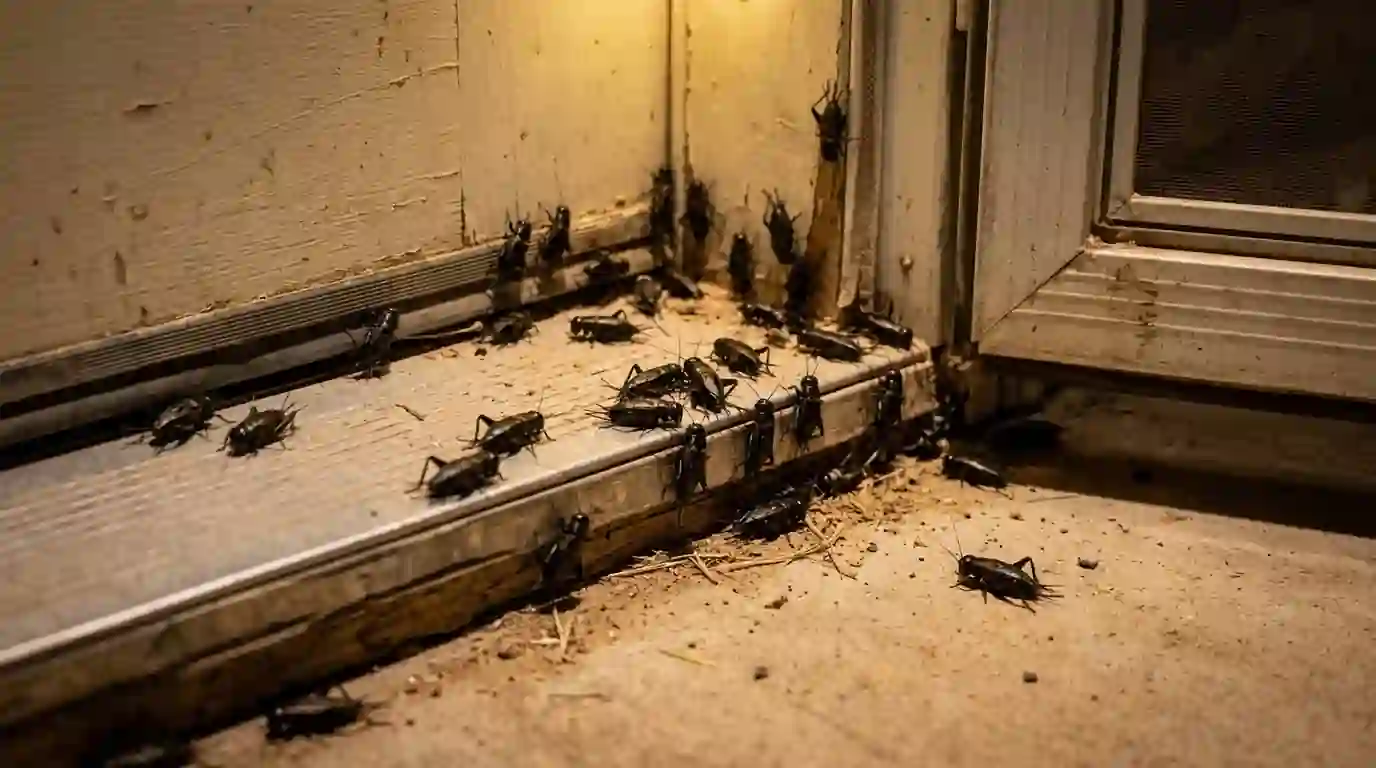
Why field crickets swarm Amarillo in August and September
Texas A&M AgriLife describes fall field cricket swarms as predictable across most of Texas, usually in August and September. The trigger is often weather: a hot, dry summer followed by rain and cooler nights. Crickets that developed through the summer reach adulthood at about the same time, and when the break in the weather comes, they take to the air on mating flights that can last a week or two. They stay active after that until the cold shuts them down, and Amarillo's average first freeze around October 20 usually marks the end.
In the Panhandle, that pattern lines up with the late part of the thunderstorm season, when an August storm can end a long dry spell almost overnight. Open fields, pasture and wheat ground around the edges of town produce huge numbers of crickets, and homes and businesses near that open land see the most. Subdivisions on the south and southwest side that back onto pasture, as well as acreage homes outside the city, often get the heaviest flights.
Lights are what bring them in close. Crickets fly at night and head for bright light, so gas station canopies, parking lots, storefronts and porch lights collect them by the thousands. A house with a bright security light over the driveway can draw crickets from a long way off, and once they land they crawl toward the nearest dark crack, which is often the gap under a door.
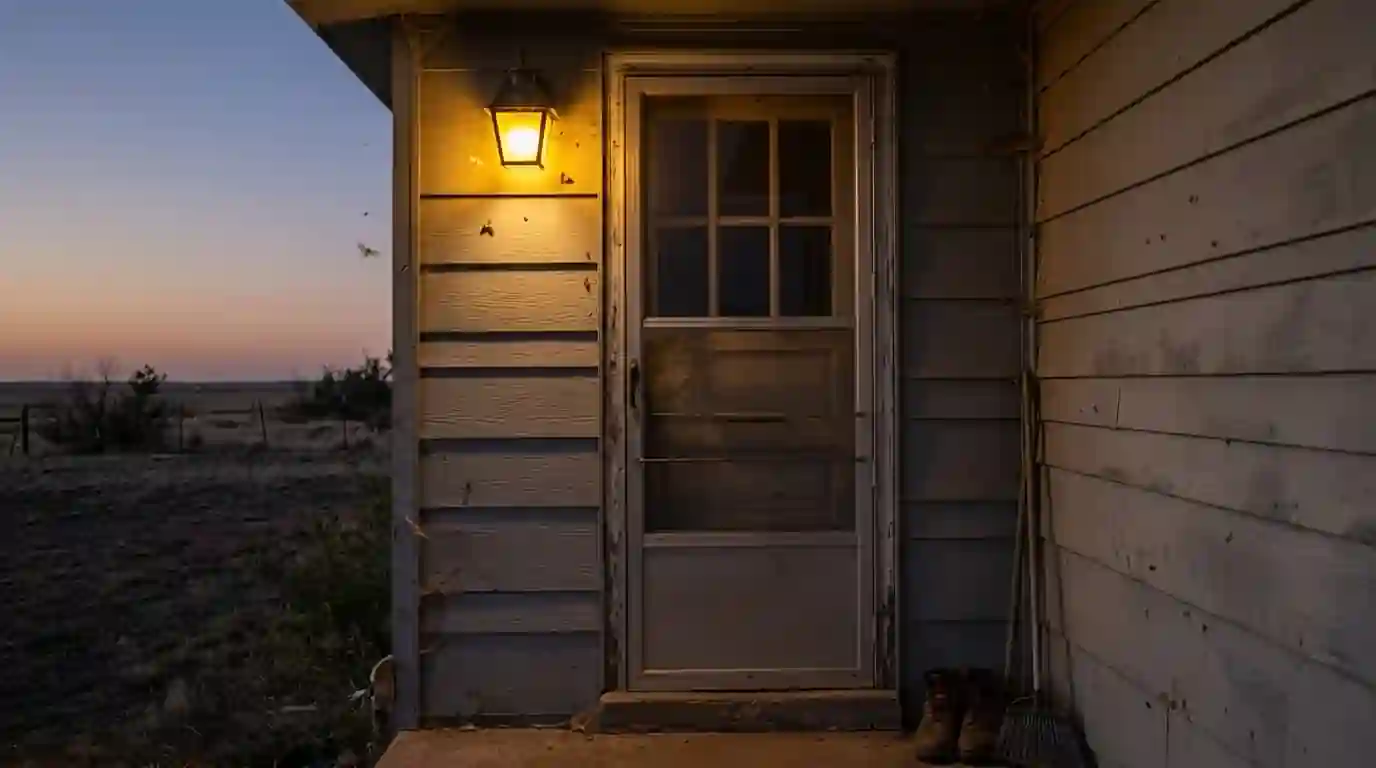
Signs a cricket swarm is reaching your home
A few crickets in late summer are normal; these signs mean numbers are building around the house.
Piles under outdoor lights
Dozens or hundreds of crickets gathered under porch lights, garage lights or a pole light in the morning.
Chirping inside at night
Males chirp to attract mates, and a single cricket in a closet or behind the dryer can keep a household awake.
Crickets in the garage
Crickets crowd into garages under shelves, in corners and behind stored boxes when the door is left open in the evening.
Bodies along thresholds
Dead and live crickets collecting at the base of doors show they are trying to get under the sweep.
Chewed fabric or paper
Crickets indoors sometimes chew on clothing, rugs and paper, especially items with food or sweat stains.
A musty smell from dead crickets
Large numbers of dead crickets in a garage, window well or behind furniture give off an unpleasant odor as they decay.
Why crickets indoors are a nuisance more than a threat
Field crickets do not breed inside a home. They need moist soil outdoors to lay eggs, so the crickets in your laundry room are adults that wandered in, not the start of an indoor population. They do not bite people in any meaningful way and do not carry disease. Inside, most of them die within days or weeks, unless they find a damp spot like a laundry room or a cluttered garage.
The trouble is the numbers, the noise and some damage. Crickets can chew holes in clothing, wool and paper, and their droppings and crushed bodies can stain carpet, upholstery and curtains. In a business, crickets piling against a glass door or crunching underfoot in the entry is a real problem for customers. And dead crickets in a closed garage or a crawlspace can draw other pests that feed on them, including scorpions and spiders.
Need cricket control in Amarillo?
Call and tell us what you are seeing. The line is answered 24 hours a day, every day.
How our technician handles a cricket swarm
A swarm visit is about the outside of the building, because that is where the crickets are.
Find where crickets collect
We walk the property looking for piles under lights, crickets along the foundation and the doors where they are getting in. Morning visits often show the clearest pattern.
Treat the perimeter band
Our technician applies a residual treatment along the foundation and a few feet out into the soil and rock beds, plus around door frames and the walls under lights. Products in the Demand CS or Suspend family are typical choices for this kind of band.
Granular bait in beds
In mulch, rock and turf near the house, a granular bait can take out crickets that the liquid band does not reach.
Check thresholds and weep holes
We look at door sweeps, garage door seals and the weep holes along the base of brick walls, where crickets crawl in. We point out gaps that need sealing or weep screens.
Review the lighting
We note which lights are pulling crickets to the doors and suggest moving them, turning them off or switching to yellow bug bulbs.
Things you can do to keep crickets away from the doors
Lighting changes and a few repairs do as much as any treatment during a swarm.
- Switch porch and garage lights to yellow bug bulbs, which draw fewer crickets.
- Turn off outdoor lights you do not need at night during August and September.
- Close blinds at night so indoor light does not shine onto the yard.
- Replace worn door sweeps and garage door bottom seals.
- Fit weep hole screens that keep crickets out but still let the wall drain.
- Keep the garage door closed in the evening.
- Sweep or vacuum up dead crickets quickly so they do not draw scorpions and spiders.
What changes the cost of cricket control in Amarillo
Cricket work is priced by how much outside surface and lighting is involved.
- Property size
- Acreage homes and properties next to open pasture need a wider treatment band than a city lot.
- Commercial frontage
- Businesses with big storefronts, canopies and parking lot lights take more time to treat.
- Swarm timing
- A treatment at the start of a flight often holds better than one at its peak, and heavy years may need a follow-up.
- Sealing needs
- Many worn door seals or open weep holes add time if they are handled on the visit.
We quote after an inspection, or by phone once we know the property size and how bad the swarm is.
The cricket season around Amarillo, month by month
Here is the general pattern of field cricket activity through the warm season.
| Time of year | What crickets are doing | What helps most |
|---|---|---|
| Late spring to early summer | Young crickets develop in fields and yards | Keep grass trimmed near the foundation |
| Midsummer | Nearly grown, numbers building in dry fields | Check door sweeps and weep holes |
| August to September | Mating flights, swarms at lights after rain | Perimeter treatment and lighting changes |
| October | Still active until the first hard freeze | Clean up dead crickets in garages |
| Winter | Eggs wait in the soil for spring | Plan sealing work before next season |
Product lines a technician may choose from, matched to the pest, the room and who lives there:
Where we handle cricket control
Neighborhoods and towns we cover most often, with ZIP codes. The rest of Amarillo and the towns in our service area are covered too.
- City View79118
- Puckett79109
- Ridgecrest79109
- Sleepy Hollow79121
- Hollywood-Scotsman79110
- Windsor79109
- Belmar79106
- The Greenways79119
- Heritage Hills79119
- South Georgia Place79110
- Wolflin79109
- Eastridge79107
- Canyon79015
- Hereford79045
- Pampa79065
- Dumas79029
- Borger79007
- Bushland79012
Cricket Control questions from Amarillo homeowners
Why are there so many crickets around Amarillo after the first late summer rain?
Because rain and cooler nights after a dry summer set off mating flights. Field crickets that matured over the summer take to the air at about the same time, and they head for lights. Texas A&M AgriLife describes these August to September swarms as predictable across most of Texas. The flight usually lasts a week or two.
Do field crickets breed inside Amarillo homes?
No. Field crickets need moist outdoor soil to lay eggs, so the ones in your home are adults that came in from outside. Most die indoors within days or weeks. A damp laundry room or cluttered garage can keep a few alive longer, which is why keeping those areas dry and tidy helps.
Do yellow bug lights really keep crickets away?
They help a lot. Crickets are drawn to bright white and blue light, and yellow bulbs draw noticeably fewer of them. Texas A&M AgriLife lists outdoor lighting as the main driver of cricket problems around buildings. Switching porch and garage bulbs, or turning off lights you do not need, is one of the cheapest fixes.
Can crickets in my Amarillo garage attract scorpions?
They can. Striped bark scorpions and spiders feed on crickets, so a garage full of live and dead crickets is a buffet. That is one reason to sweep up dead crickets promptly and close garage gaps during swarm season. If you are seeing scorpions too, tell us when you call so we treat for both.