Bird control for Amarillo roofs, signs and buildings
Pigeons on a roofline, sparrows nesting in a sign and starlings packed into a vent leave droppings, noise and blocked airflow.We remove nests where the law allows and install spikes, netting and other deterrents so the birds move on.
How do you keep pigeons and sparrows off a building in Amarillo?
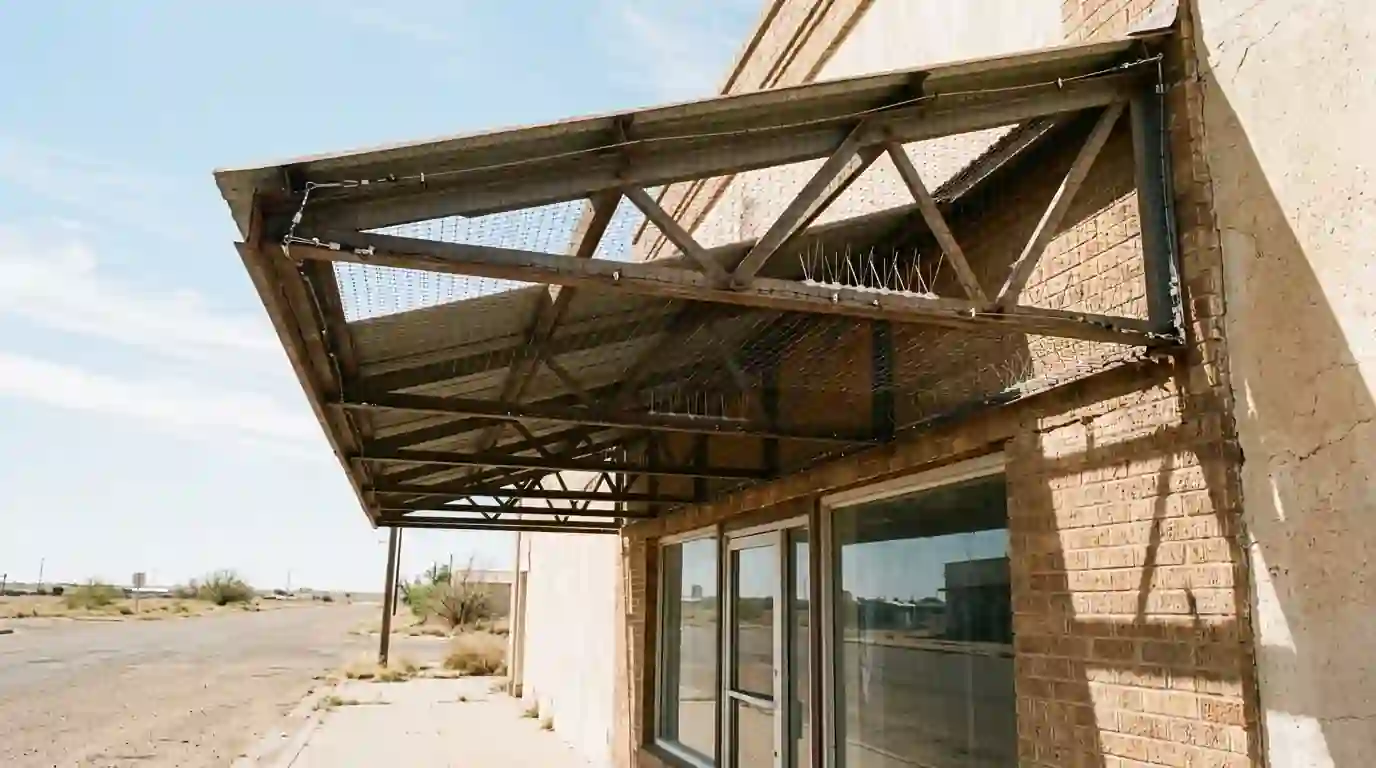
Keeping pigeons, sparrows and starlings off a building means removing nests and making their favorite perches and nesting spots unusable. Our technician identifies the birds, clears nests of unprotected species, cleans the area, then installs spikes on ledges, netting over recesses and screens over vents. Protected birds are moved along with deterrents only.
Which birds can be removed under Texas law
Texas Parks and Wildlife Code section 64.002 lists three birds as unprotected: rock pigeons (rock doves), house sparrows and European starlings. None of them are native, and their nests and eggs may be removed. These three cause most of the bird problems we see in Amarillo, from pigeons on downtown ledges and grain buildings to sparrows nesting in store signs and starlings packing dryer and bathroom vents with grass.
Most other birds are protected by state and federal law, which means their nests, eggs and the birds themselves cannot be disturbed without proper authorization. That covers songbirds, swallows, doves other than rock pigeons, hawks and owls, among others. For those birds, our technician uses deterrents only, and if an active nest of a protected species is found, we leave it alone and plan around it.
Amarillo's grain elevators, feed buildings and the feedyards around Hereford give pigeons and starlings steady food, and flocks move between those sites and downtown roofs, signs and warehouses.
Bird problems we see on Amarillo homes and businesses
Birds create more trouble than most people expect once a flock settles in.
Droppings on walks and entries
White streaks on sidewalks, storefronts, loading docks and parked cars under ledges and signs, which customers notice first.
Nests in vents
Starlings and sparrows stuff dryer, bathroom and kitchen vents with grass and feathers, blocking airflow and creating a lint fire risk.
Birds in signs and light fixtures
Sparrows nesting inside channel letter signs, canopy lights and gaps above awnings, with debris falling below.
Pigeons on rooftop equipment
Flocks roosting on HVAC units and parapets, with droppings building up around intakes and on roof membranes.
Clogged gutters and drains
Nesting material and droppings blocking gutters and roof drains, which can back water up in a storm.
Mites and insects indoors
Bird mites and carpet beetles can move indoors from old nests in walls, vents and attics.
Matching the deterrent to the problem
Each kind of perch or nesting spot calls for a different tool.
| Problem spot | Deterrent | How it works |
|---|---|---|
| Ledges, parapets and sign tops | Bird spikes | Blunt spikes make the surface too awkward to land on |
| Recessed areas, canopies and loading docks | Bird netting | Closes off the space so birds cannot get in to roost or nest |
| Dryer, bath and gable vents | Vent guards and screens | Lets air out but keeps birds from building nests inside |
| Roof edges and beams | Low-profile wire or slope covers | Removes the flat surface pigeons rely on |
| Gaps in soffits and signs | Sealing and mesh | Closes the cavity birds use for nesting |
Need bird control in Amarillo?
Call and tell us what you are seeing. The line is answered 24 hours a day, every day.
What happens on a bird control visit
Our technician starts with the birds' habits, because that tells us where deterrents will work.
Identify the birds
We confirm which species are involved. That decides whether nests can be removed or only deterrents can be used.
Map roosts and nests
We note where birds perch during the day, where they roost at night and where they nest, since those are often different spots on the same building.
Remove nests of unprotected birds
Nests of pigeons, house sparrows and starlings are removed and bagged. Nests of protected birds stay untouched.
Clean the area
Droppings and nest debris are cleaned off the surfaces where deterrents will go, with protective gear, since buildup can harbor bacteria and fungal spores.
Install deterrents
Spikes, netting, vent guards or sealing go in where the birds actually land and nest, fastened to stand up to Panhandle wind.
Check results
Birds test deterrents, so we look at the site again to see whether they shifted to a new ledge or gap.
Why bird deterrents have to be built for the wind
The Weather Channel has ranked Amarillo the windiest city in the US, and gusts past 50 mph hit most years. Netting that is loosely fastened sags, flaps and tears, and spikes glued to a dusty ledge can pop off within a season. Our technician cleans surfaces before installing, uses fasteners suited to brick, metal or wood, and tensions netting on cables so it holds its shape.
Wind also shapes where birds roost. Pigeons and starlings tuck into the sheltered side of buildings, under canopies and in recessed doorways out of the gusts, especially when a cold front pushes through. Those protected spots are where droppings build up fastest, and where netting or slope covers do the most good.
What you can do to make your property less attractive to birds
Deterrents work best when birds also lose their easy food and water.
- Keep dumpster lids closed and pick up spilled food around loading areas.
- Do not feed pigeons, and ask employees and tenants not to either.
- Clean up spilled grain and feed around barns and feed rooms.
- Keep vent covers in place and check them each spring for nesting material.
- Clear gutters and roof drains of nesting debris before storm season.
- Avoid sweeping dry droppings; wet them first and wear gloves and a mask.
What changes the cost of bird control in Amarillo
Bird control is priced on the site, the birds and the deterrent that fits.
- Type and size of the area
- A single home vent is very different from a downtown roofline or a grain building.
- Deterrent chosen
- Spikes along a ledge, netting over a loading dock and vent guards each take different material and time.
- Height and lift access
- Rooflines, signs and high ledges may need tall ladders or a lift.
- Cleanup needed
- Heavy droppings and nest buildup add cleaning time before deterrents go up.
- Number of birds
- Large, established flocks may test deterrents longer and need follow-up adjustments.
We quote after looking at the building, or by phone once we know the birds and the spots they use.
Product lines a technician may choose from, matched to the pest, the room and who lives there:
Where we handle bird control
Neighborhoods and towns we cover most often, with ZIP codes. The rest of Amarillo and the towns in our service area are covered too.
- City View79118
- Puckett79109
- Ridgecrest79109
- Sleepy Hollow79121
- Hollywood-Scotsman79110
- Windsor79109
- Belmar79106
- The Greenways79119
- Heritage Hills79119
- South Georgia Place79110
- Wolflin79109
- Eastridge79107
- Canyon79015
- Hereford79045
- Pampa79065
- Dumas79029
- Borger79007
- Bushland79012
Bird Control questions from Amarillo homeowners
Can I remove pigeon and sparrow nests in Amarillo?
Yes. Under Texas Parks and Wildlife Code section 64.002, rock pigeons, house sparrows and European starlings are unprotected, and their nests and eggs may be removed. Most other birds are protected, so their nests must be left alone. If you are not sure which bird is nesting, let our technician identify it before anything is removed.
Why are starlings nesting in my dryer vent in Amarillo?
Starlings and sparrows look for small, warm, sheltered cavities, and a dryer or bath vent without a guard is a perfect fit. Nests block airflow and can cause lint to build up, which is a fire risk. We remove the nest, clean the vent opening and install a guard that lets air out but keeps birds from getting in.
Do bird spikes hurt pigeons on Amarillo buildings?
No. Bird spikes have blunt tips and work by making a ledge too awkward to land on, not by injuring the birds. Pigeons simply move to a different spot. We fasten spikes to clean surfaces so they hold up in wind, and pair them with netting or vent guards where birds roost or nest in recessed areas.
What bird control options work for grain and feed buildings near Amarillo?
For grain and feed buildings, the main steps are cleaning up spilled grain, netting off rafters and open bays where pigeons and starlings roost, closing gaps in walls and eaves, and removing nests of unprotected species. Food is the main draw at these sites, so bird control works best combined with good feed storage and cleanup.