Termite control for Amarillo homes on slab and pier
Native subterranean termites live in the soil under Amarillo and work their way into houses through mud tubes you rarely see.We treat active termites with a non-repellent liquid barrier, a bait system or both, chosen for how your house is built.
How do you get rid of termites in an Amarillo house?
Termites in an Amarillo house are usually native subterranean termites coming up from the soil. Our technician confirms the activity, finds where they enter, then treats the soil along the foundation with a non-repellent liquid that termites carry back to the colony, or installs bait stations around the house. Moisture problems that drew them in are fixed at the same time.
Signs of termites in an Amarillo house
Subterranean termites stay hidden, so these clues are usually all you get.
Mud tubes on the foundation
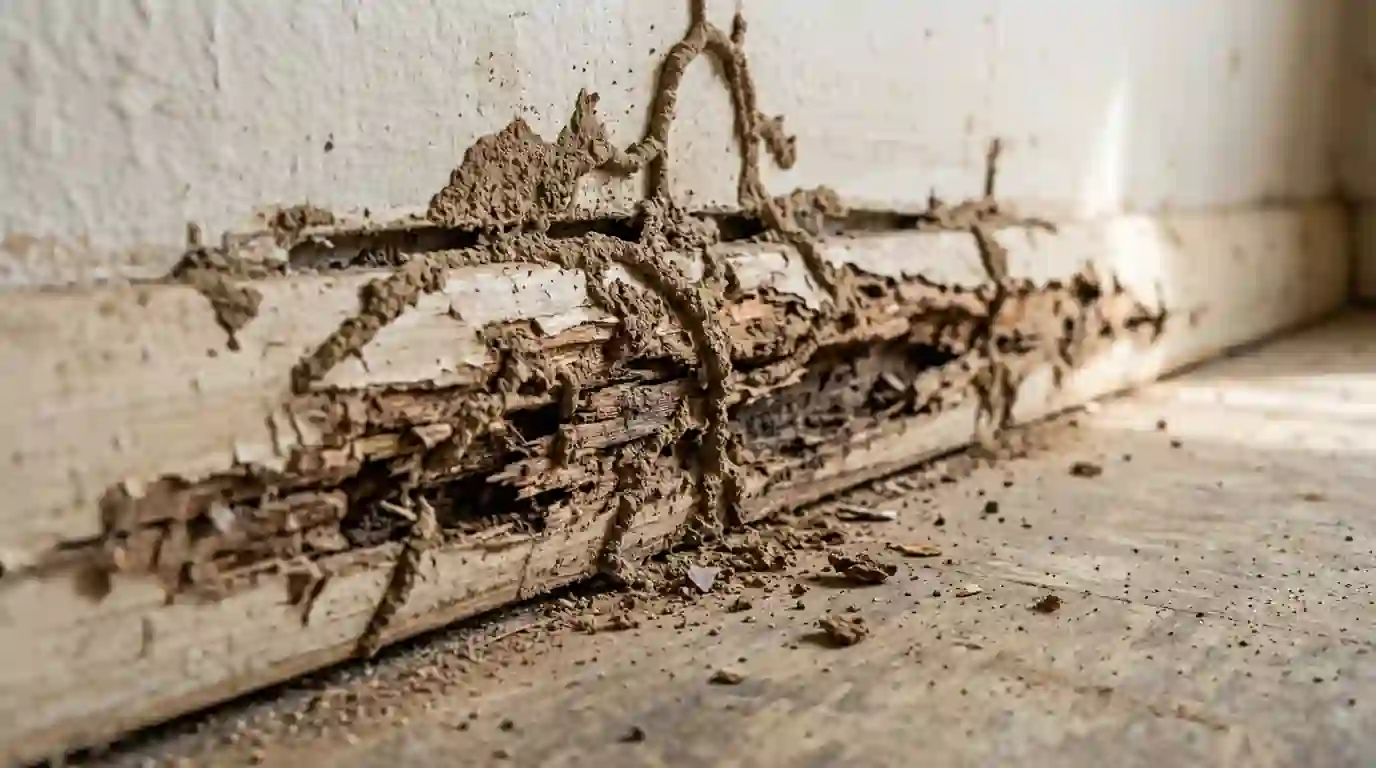
Pencil-wide tubes of soil running up the slab edge, a foundation wall or a pier are termite highways from the soil to the wood.
Wings on windowsills
Little heaps of identical wings near windows or doors in April and May mean a swarm happened indoors or close by.
Swarmers coming out of a wall
Dozens of small dark insects with long wings coming from a baseboard, door frame or slab crack on a warm spring day.
Hollow-sounding trim
Baseboards or door trim that sound hollow or give when pressed, sometimes with soil packed into small holes.
Bubbling paint or sagging drywall
Termites working behind drywall can leave faint lines, blisters in paint or soft spots, often near a bathroom or kitchen.
Damage in wood touching soil
Fence posts, landscape timbers and deck supports in the ground show termite galleries first and point to activity near the house.
Liquid barrier or bait: which fits your house
Both methods work on native subterranean termites; the house and the situation decide which is better.
| Question | Non-repellent liquid barrier | Bait stations |
|---|---|---|
| How it works | Treated soil along the foundation; termites pass through, pick it up and spread it to others | Termites feed on bait in stations set in the ground and carry it back to the colony |
| How fast it acts | Usually faster on an active infestation | Slower, since termites have to find and feed on the bait |
| What it involves | Trenching soil and drilling through slab edges, patios or driveways where needed | Stations set into the soil every few feet around the house, little drilling |
| Ongoing work | Mostly a one-time treatment with periodic inspections | Regular monitoring visits to check and refill stations |
| Good fit for | Active infestations, homes where trenching and drilling are practical | Homes with lots of concrete around them, or owners who want to avoid drilling |
| Example products | Termidor | Sentricon or similar systems |
What happens on a termite treatment
This is how a typical liquid treatment goes on a brick slab home.
Inspect and map the activity
The technician inspects the inside and outside of the foundation, the garage, plumbing penetrations and any crawlspace. Active tubes, damage and moisture problems are marked on a diagram of the house.
Trench the soil along the foundation
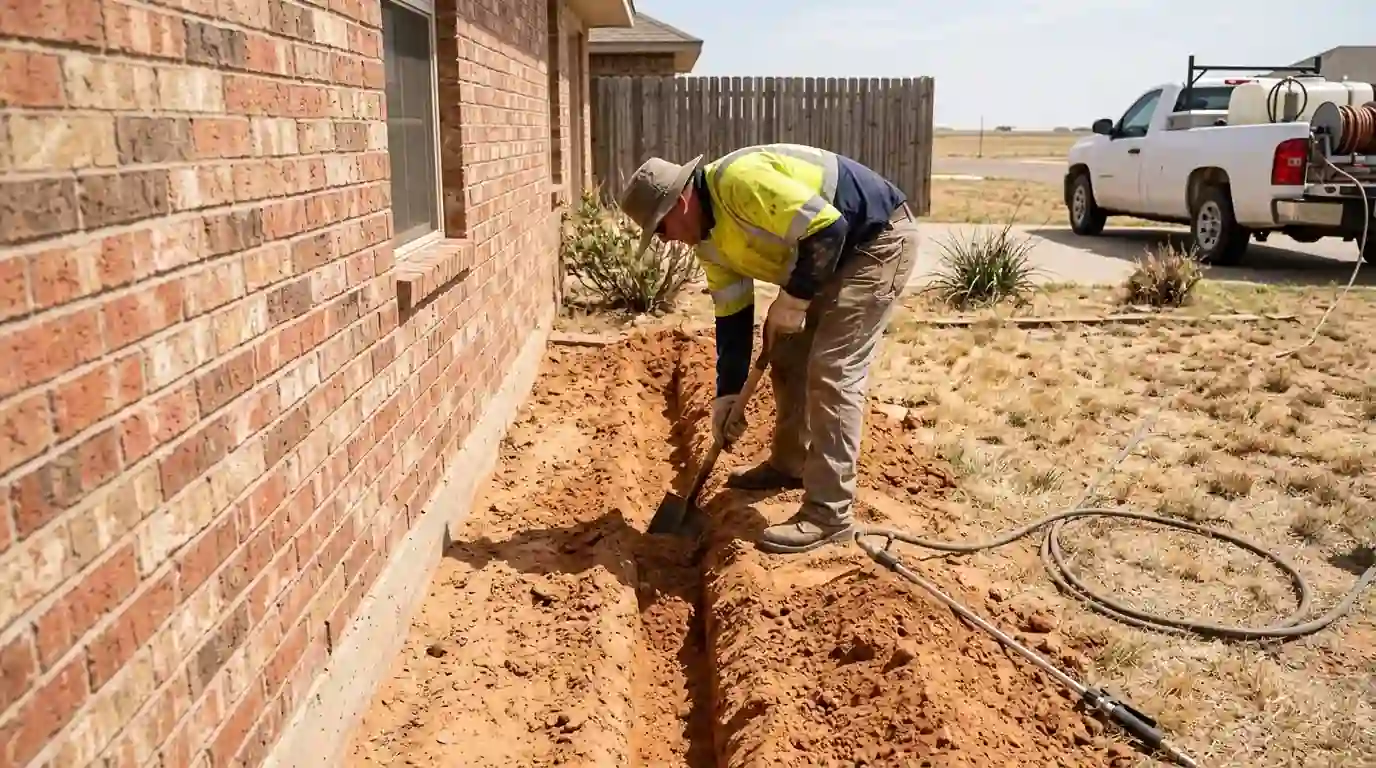
A narrow trench is dug along the outside of the foundation where soil meets the slab. The non-repellent liquid goes into the trench and the soil is treated as it goes back in.
Drill through concrete where needed
Where a patio, sidewalk or driveway butts against the house, small holes are drilled through the concrete so the soil underneath can be treated. Holes are patched afterward.
Treat inside entry points
Where termites are active inside, such as around a bathtub drain or a crack in the garage slab, those spots get localized treatment.
Fix what drew them in
We point out moisture problems, wood touching soil and soil piled above the foundation line, and explain what needs to change so the treatment is not working against those conditions.
Need termite control in Amarillo?
Call and tell us what you are seeing. The line is answered 24 hours a day, every day.
Termites in Panhandle soil and Amarillo houses
According to Texas A&M AgriLife, native subterranean termites turn up in every region of the state, and the Panhandle is no exception. Our climate is drier than East Texas, but termites live in the soil, not the air. Heavy clay soil holds water, and Amarillo's thunderstorm rains, about three quarters of our yearly 19.7 inches falling between April and September, keep the ground moist enough for colonies to thrive under lawns and foundations.
Panhandle swarms happen in April and May, much later than the January and February swarms in South Texas. On a warm day after a spring rain, winged termites leave the colony in a short burst. If that happens inside, it means the colony has a way into the house. The Formosan species has not been documented in the Panhandle and drywood termites are rare out here, so nearly every termite we treat is a native subterranean.
Most Amarillo homes are brick on slab, with weep holes spaced along the lowest course of brick veneer. Termites can travel through cracks in the slab, around plumbing penetrations and behind brick veneer where it meets the foundation. When landscape rock, mulch or soil is piled above the foundation line or over the weep holes, termites gain a hidden path into the wall. Older homes from the 1920s to 1940s on pier-and-beam foundations give termites piers and crawlspace wood to climb instead.
What changes the cost of termite control in Amarillo
Termite jobs vary a lot, so we price after looking at the house.
- Linear feet of foundation
- Liquid treatments are figured largely by the distance around the house. Bigger homes and attached garages take more trenching and material.
- Concrete against the house
- Patios, sidewalks and driveways touching the foundation need drilling to reach the soil underneath.
- Liquid, bait or both
- Bait systems involve installation plus ongoing monitoring; liquid treatments are mostly up front. Some homes get a combination.
- Foundation type
- Pier-and-beam homes with crawlspaces need different work than slab homes.
- Extent of activity
- Several active areas or damage in more than one wall can mean more localized interior treatment.
We quote termite work after an inspection, since we need to measure the foundation and see the activity.
How to make your house less inviting to termites
These fixes work alongside treatment and make re-infestation less likely.
- Hold soil, rock and mulch several inches below the top edge of the slab and clear of weep holes.
- Route AC condensate lines and gutter downspouts so water drains away from the slab.
- Fix leaking outdoor faucets and irrigation heads that spray the foundation.
- Get firewood, scrap lumber and cardboard up off the soil and well clear of the house.
- Replace landscape timbers and fence posts touching the house with non-wood material.
- Do not break up or scrape mud tubes before an inspection; they show us where termites travel.
- Drop a few swarmers or wings into a zip bag so we can confirm what they are.
What to do if termites swarm inside your house
A swarm in the house is alarming, but the swarmers themselves do not chew wood or sting, and they die within hours. Vacuum them up, keep a handful in a zip bag or jar, and note where they came from: a baseboard, a slab crack or a door frame. That location is valuable information for the inspection.
Do not spray the area or seal the crack where they came out. That does nothing to the colony in the soil and can hide where termites are entering. Call us and we will set up an inspection to find out how far the activity goes and which treatment fits. Termite damage builds over months and years, so a few days to plan properly will not change the outcome.
Product lines a technician may choose from, matched to the pest, the room and who lives there:
Where we handle termite control
Neighborhoods and towns we cover most often, with ZIP codes. The rest of Amarillo and the towns in our service area are covered too.
- City View79118
- Puckett79109
- Ridgecrest79109
- Sleepy Hollow79121
- Hollywood-Scotsman79110
- Windsor79109
- Belmar79106
- The Greenways79119
- Heritage Hills79119
- South Georgia Place79110
- Wolflin79109
- Eastridge79107
- Canyon79015
- Hereford79045
- Pampa79065
- Dumas79029
- Borger79007
- Bushland79012
Termite Control questions from Amarillo homeowners
Do termites really live in Amarillo, given how dry it is?
Yes. Native subterranean termites are found statewide, Panhandle included, according to Texas A&M AgriLife. They live in the soil, where moisture from clay, thunderstorm rain, irrigation and leaks keeps them going even when the air is dry. Swarms here come in April and May. The Formosan species has not been documented in the Panhandle, and drywood termites are rare.
What is a non-repellent termite treatment?
A non-repellent treatment is a liquid applied to the soil that termites cannot detect. Instead of avoiding the treated zone, they tunnel through it, pick up the active ingredient and pass it to other termites through contact and feeding. That spreads the effect back into the colony rather than just blocking the termites at the foundation. Termidor is one example.
Will you need to drill through my patio for termite treatment in Amarillo?
If a patio, sidewalk or driveway touches the foundation where termites could travel, the soil under it has to be treated, and drilling small holes through the concrete is how that is done. The holes are spaced along the slab edge and patched afterward. If you would rather avoid drilling, a bait station system may be an alternative.
How long does termite treatment take on an Amarillo slab home?
A liquid treatment on an average brick slab home usually takes most of a day, depending on the length of the foundation and how much concrete needs drilling. Bait station installs often go faster but need monitoring visits afterward. You do not need to leave the house, though we ask you to keep kids and pets away from open trenches until the soil is back in place.
Should I buy a house in Amarillo that had termites?
A house with a termite history can still be a sound buy if the termites were treated properly and the damage was repaired. Ask for treatment records and any Wood Destroying Insect Report, and have a new inspection done before closing. The report notes visible activity, damage and conditions that attract termites, which helps you judge whether the problem was handled.