Snake removal for Amarillo homes and acreage
A snake coiled by the back door, in the garage or under the AC unit needs to be identified before anyone gets close.We answer 24/7, remove the snake, and look at what drew it to your property so another is less likely to show up.
What should I do if I find a snake at my house in Amarillo?
If you find a snake at your house, back away at least six feet, bring kids and pets inside, and keep an eye on where it goes from a safe distance. Do not try to kill or catch it. Call us and our technician will identify and remove the snake, then check for cover, rodents and gaps that drew it in.
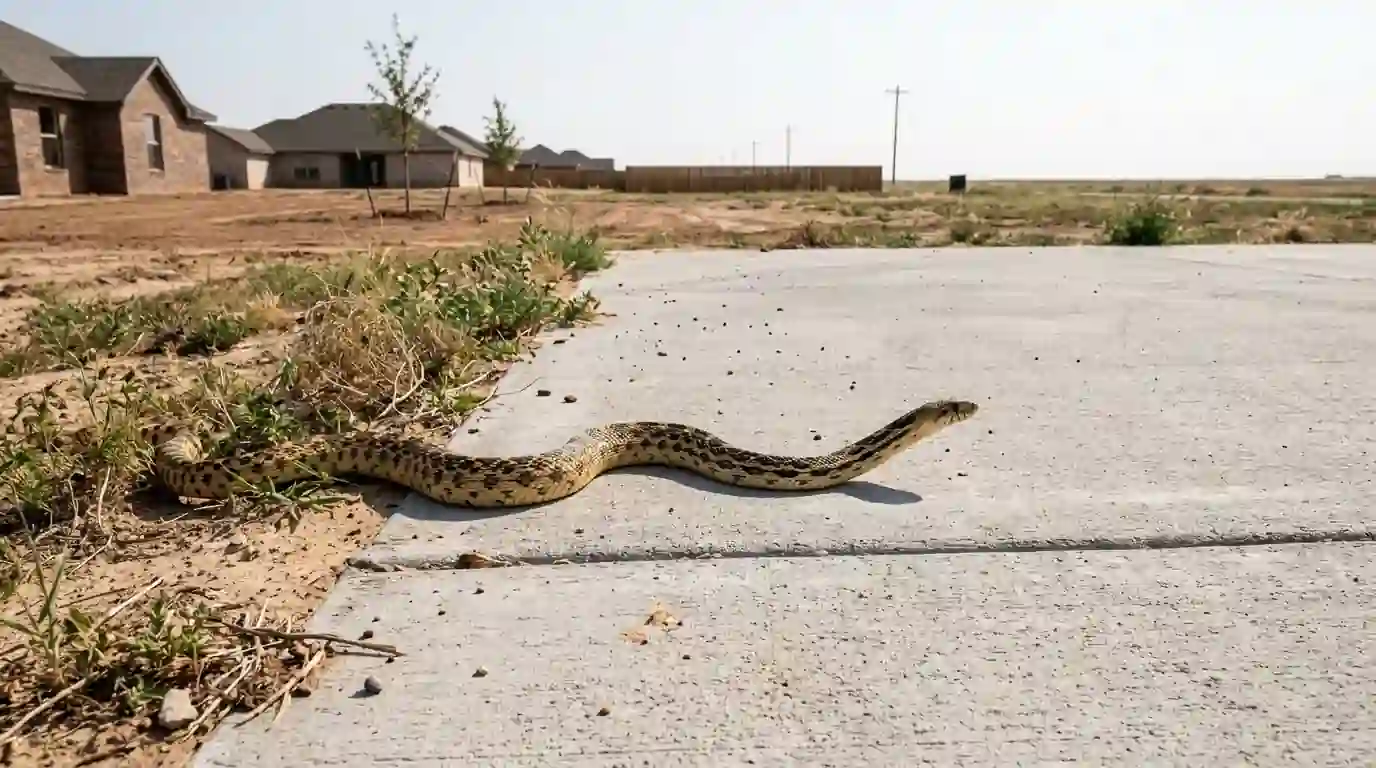
What to do while you wait for us
These steps keep everyone safe until our technician arrives.
- Step back at least six feet; most bites happen when people try to kill or handle a snake.
- Bring children and pets inside, or leash dogs and move them well away.
- Watch where the snake goes from a safe distance, so we know where to look.
- If it is in a garage or room, close the door and put a towel along the gap at the bottom.
- Do not reach under decks, woodpiles, AC units or into dark corners to look for it.
- If someone is bitten, keep them calm and still, remove rings and tight items, and call 911 right away.
Snakes we most often find around Amarillo
Telling these apart matters, but keep your distance and let us confirm the identification.
| Snake | How to recognize it | Where it turns up |
|---|---|---|
| Western diamondback rattlesnake | Heavy body, dark diamond pattern, black and white bands before the rattle | Rocky edges, brush, woodpiles, under sheds; venomous |
| Prairie rattlesnake | Greenish or tan with brown blotches, rattle on the tail | Grassland, pasture edges and canyon country; venomous |
| Bullsnake | Large, yellow-tan with dark blotches, hisses loudly and vibrates its tail | Fields, barns and yards hunting rodents; not venomous |
| Coachwhip | Long and slender, very fast, often dark at the head fading to tan | Open ground and roadsides in the heat of the day; not venomous |
Why snakes show up at the edges of Amarillo
The western diamondback is the most widespread rattlesnake in Texas, and the prairie rattlesnake lives in arid grassland and canyon country like the breaks around Palo Duro and Lake Meredith. Most snakes we get called about turn up at the edges of town and in new subdivisions on the south and southwest side, where homes back onto open pasture. Construction scrapes away the grass and burrows snakes were using, and they move toward the nearest cover, which is often a new backyard.
Local snakebites peak in July and August, when snakes are most active and people spend evenings outside. Snakes hunt rodents, so a property with mice or rats, a woodpile, an old shed on blocks or tall grass along the fence draws them in. Water matters too: a dripping AC condensate line or a pet bowl on a hot day can bring a snake right up to the slab. Acreage homes outside town and the wooded draws around places like Lake Tanglewood are typical summer snake spots.
Need snake removal in Amarillo?
Call and tell us what you are seeing. The line is answered 24 hours a day, every day.
Signs a snake may be using your property
Snakes are good at hiding, so most of the evidence is indirect.
Shed skins
Papery, see-through skins in a garage corner, along the foundation, in a woodpile or under a deck.
A rodent problem nearby
Mice in the garage or rats under a shed draw snakes, especially bullsnakes and rattlesnakes.
Dense cover against the house
Woodpiles, stacked lumber, thick shrubs and debris along the foundation give snakes shade and shelter.
Gaps under doors and sheds
Daylight under a garage door or a shed floor sitting on blocks with open sides lets snakes in.
Pets fixating on one spot
A dog barking or a cat stalking at the edge of a deck or behind the AC unit.
A rattling sound
A dry buzz from grass or brush is a warning. Bullsnakes mimic it, but treat every rattle as real and back away.
How our technician removes a snake
We work slowly and from a distance, with the right tools for the snake in front of us.
Get the details on the phone
Our office asks where you last saw the snake, what it looks like and where people and pets are. That tells our technician what to expect on arrival.
Locate and identify
Our technician finds the snake, keeping a safe distance, and identifies it. Bullsnakes and rattlesnakes can look alike at a glance, so we check head shape, pattern and tail.
Capture with tongs and a container
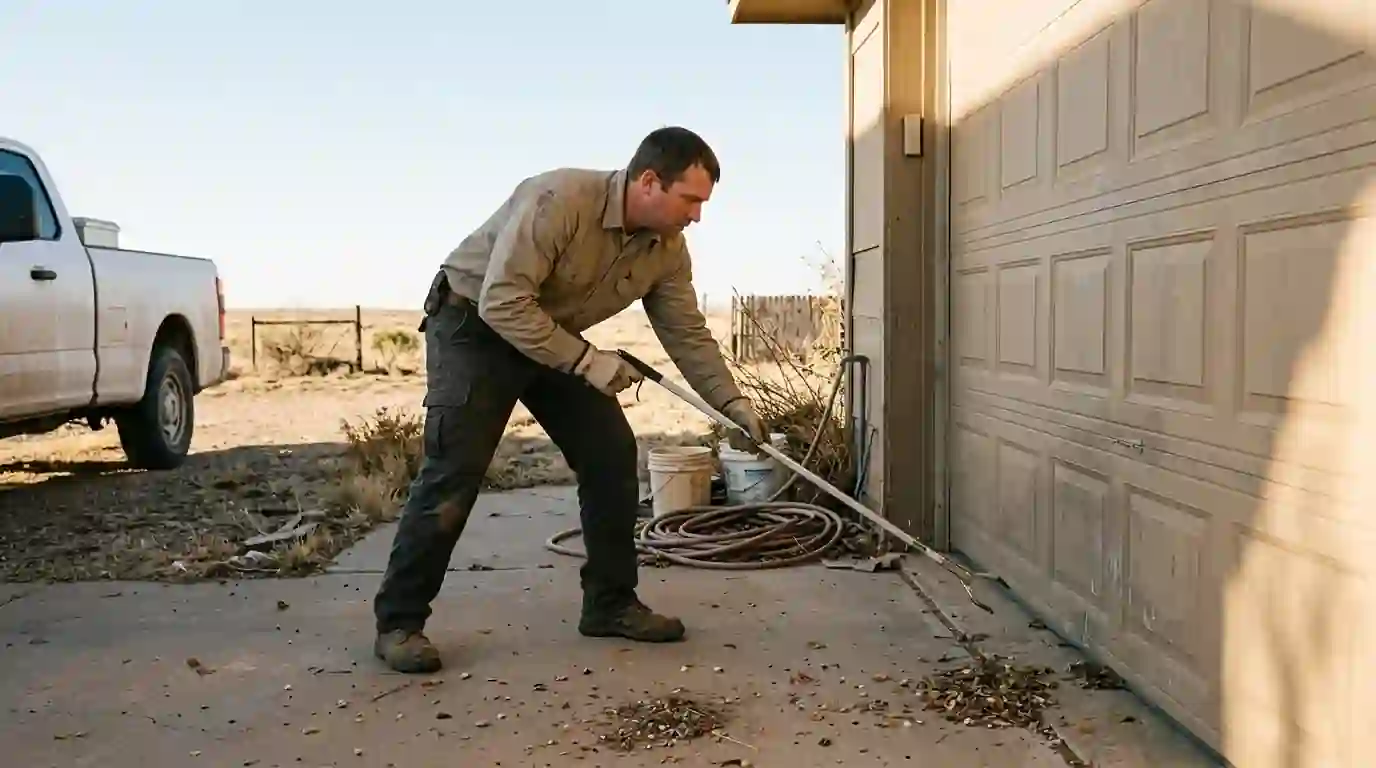
We use long snake tongs or a hook to secure the snake and place it in a locking container, without harming it or putting anyone at risk.
Search nearby hiding spots
We check under decks, behind the AC unit, in woodpiles and inside the garage for other snakes or a den.
Remove it from the property
The snake leaves with our technician and is handled away from homes.
Walk the property for causes
We point out the rodents, cover, water and gaps that drew the snake in and suggest what to change.
Making your yard less appealing to snakes
No yard on the edge of town can be made snake-proof, but you can make yours much less interesting. Snakes come for food, cover and cool shade. Take away the rodents and the hiding places, and a passing snake has little reason to stay. Keep grass mowed short along fences and around the house, move woodpiles and lumber off the ground and away from walls, and clear brush, rocks and junk from the foundation line.
Close gaps that let snakes into garages, sheds and crawlspaces: a worn garage door seal, an open crawlspace vent or a shed floor on blocks with open sides. Fixing a rodent problem is often the biggest single step, since mice and rats are what bullsnakes and rattlesnakes are hunting. Sprays and granules sold as snake repellents rarely help, and a tidy yard with no rodents to hunt does more.
What changes the cost of snake removal in Amarillo
Snake calls range from a quick pickup to a search through a crowded garage or crawlspace.
- Where the snake is
- A snake in plain view on the patio is faster than one hidden in a crawlspace, wall or cluttered garage.
- Time of the call
- After-hours and overnight calls can affect the visit, and we explain that when you call.
- Distance from Amarillo
- Acreage farther out on the Panhandle takes more travel time than a city lot.
- Follow-up habitat work
- Sealing gaps under sheds and garages or treating a rodent problem adds to a basic removal.
We give you a quote over the phone once we know where the snake is and how easy it is to reach.
Product lines a technician may choose from, matched to the pest, the room and who lives there:
Where we handle snake removal
Neighborhoods and towns we cover most often, with ZIP codes. The rest of Amarillo and the towns in our service area are covered too.
- City View79118
- Puckett79109
- Ridgecrest79109
- Sleepy Hollow79121
- Hollywood-Scotsman79110
- Windsor79109
- Belmar79106
- The Greenways79119
- Heritage Hills79119
- South Georgia Place79110
- Wolflin79109
- Eastridge79107
- Canyon79015
- Hereford79045
- Pampa79065
- Dumas79029
- Borger79007
- Bushland79012
Snake Removal questions from Amarillo homeowners
How can I tell a bullsnake from a rattlesnake in my Amarillo yard?
From a distance it can be hard, which is why you should treat every large snake as dangerous. Bullsnakes hiss loudly, flatten their heads and vibrate their tails in dry grass to sound like a rattle, but they have no rattle. Rattlesnakes have heavy bodies and a segmented rattle on the tail. Stay back and let us identify it.
When are rattlesnakes most active around Amarillo?
Rattlesnakes are active from spring through fall, and local snakebites peak in July and August. In the heat of summer, snakes move more at dusk, at night and early in the morning. Be careful in tall grass, around woodpiles and when reaching under decks, sheds or AC units during snake season.
Why are there more snakes in new subdivisions near Amarillo?
Construction clears grass and burrows that snakes and their prey were using, so the snakes move toward the nearest cover. New homes on the south and southwest edge of Amarillo back onto open pasture, and fresh yards with lumber, debris and rodents give displaced snakes a place to go. Activity usually settles once construction ends.
Do snake repellents work around Amarillo homes?
Most products sold as snake repellents show little real effect. What keeps snakes away is removing what they are looking for: rodents, shelter and shade. Short grass, woodpiles off the ground, a cleared foundation line and sealed gaps under sheds and garage doors do far more than granules or sprays.
What should I do if my dog is bitten by a snake in Amarillo?
Get your dog to a veterinarian right away and keep it as calm and still as you can on the way. Do not cut the bite, apply ice or use a tourniquet. If you can do it safely from a distance, note what the snake looked like, but never try to catch it. Then call us for snake removal.