Pantry moth and beetle control in Amarillo
Small moths fluttering out of the cabinet or tiny brown beetles in the flour usually mean one infested package has seeded the whole pantry.We help you find the source, clear it out, treat the shelves and monitor with traps, and we answer 24/7.
How do you get rid of pantry moths and grain beetles in an Amarillo kitchen?
You get rid of pantry pests by finding and throwing out every infested food package, then cleaning and treating the empty shelves. Our technician inspects the pantry with you, checks pet food and bird seed, treats cracks and shelf supports, and sets pheromone traps to track Indian meal moths. You store dry food in sealed hard containers and watch the traps for several weeks.
Clues that pantry pests have moved into your food
These signs often show up in the cabinet before you ever spot a live insect in the food.
Small moths at dusk
Indian meal moths are about half an inch long with wings that are pale near the body and coppery toward the tips. They fly in a zigzag around the kitchen in the evening.
Webbing in cereal or flour
Moth larvae spin silk as they feed, so clumped flour, cereal stuck together in strands or webbing in the corners of a bag is a sure sign.
Cocoons on the ceiling
When larvae finish feeding they crawl away from the food to spin cocoons, often at the joint where the wall meets the ceiling, inside cabinet hinges and on the underside of shelves.
Tiny brown beetles
Sawtoothed grain beetles are about a tenth of an inch long, flat and brown, with little saw-like teeth along the sides of the body. They show up in oats, rice, crackers and dried fruit.
Bugs in the pet food bin
Dry dog food, cat food, bird seed and wildflower seed kept in the garage are some of the most common starting points for an infestation.
Tiny holes in packaging
Pinhole openings in cardboard boxes or plastic bags, with fine dust around them, show where larvae or beetles chewed in or out.
How one bag of birdseed can spread through a kitchen
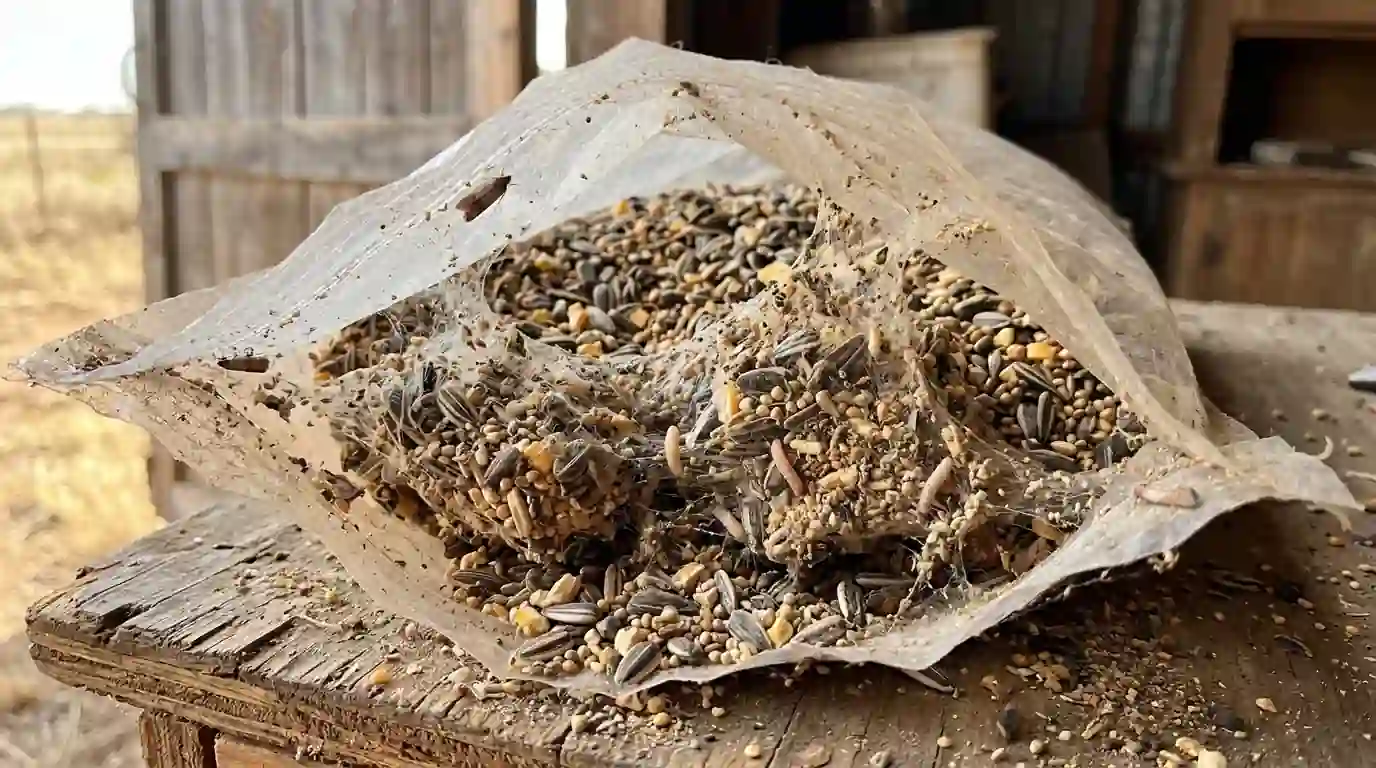
Pantry pests rarely come from a dirty kitchen. Most of the time they arrive in a product that was already infested at low levels when you bought it, often bird seed, pet food, dried beans, nuts or a bag of flour that sat in a warehouse. Eggs and tiny larvae are almost impossible to see. Once that package sits on the shelf for a few weeks in a warm kitchen, the moths or beetles mature and start looking for the next food source.
Sawtoothed grain beetles are especially good at spreading because their flat bodies slip through folds in cardboard and the tiny gaps in boxes that look sealed. Indian meal moth larvae can chew through thin plastic. That is how an open bag of bird seed in the garage turns into moths in the kitchen cabinet and beetles in the pasta a month later. It also explains why spraying the kitchen without clearing the food never works for long: the food is where they live, eat and breed.
What happens on a pantry pest visit
Pantry work is mostly careful inspection, with targeted treatment once the food is out of the way.
Identify the pest
Our technician looks at moths, larvae or beetles to confirm whether you have Indian meal moths, sawtoothed grain beetles or something else. The answer changes where we look and how long monitoring takes.
Inspect every food item with you
We go through the pantry shelf by shelf, opening boxes and bags of grains, cereal, flour, pasta, nuts, spices, dried fruit and pet treats. We also check the garage, the bird seed and any dog or cat food storage.
Clear and vacuum the shelves
Once infested food is bagged and out of the house, the shelves are emptied and vacuumed, paying close attention to shelf pin holes, corners and the crack at the back where crumbs collect.
Treat cracks and cocoon sites
We apply a targeted crack-and-crevice treatment to shelf supports, cabinet hinges and the wall-to-ceiling joint where cocoons were found. An insect growth regulator such as Gentrol can help break the moth life cycle in those spots.
Set pheromone traps
Pheromone traps baited for Indian meal moths go in the pantry and nearby cabinets. They catch male moths and show us whether breeding continues over the following weeks.
Need pantry pest control in Amarillo?
Call and tell us what you are seeing. The line is answered 24 hours a day, every day.
Keeping your pantry clear after the cleanout
A few storage habits stop the next infested package from spreading.
- Move flour, oats, rice, cereal and pasta into glass or hard plastic containers with tight lids.
- Freeze new bags of flour, cornmeal or bird seed for four days before putting them away.
- Store pet food and bird seed in sealed bins, not in their original paper bags.
- Buy bird seed in smaller amounts so it does not sit for months.
- Wipe up spilled crumbs and flour in shelf corners and drawer tracks.
- Use the oldest food first so nothing sits in the back for a year.
- Leave pheromone traps in place and tell us if the catch goes up.
Where pantry pests hide in Panhandle homes and garages
Many Amarillo households keep a lot of food in the garage: a chest freezer, bulk bags of dog food, sacks of corn or deer feed, and bird seed for the backyard feeders. Garages here swing between hot summer afternoons and cold nights, and a bag left on the floor or a shelf can harbor moths and beetles well away from the kitchen where nobody checks. When people tell us they cleaned out the pantry and the moths came back, the source is often a sack in the garage.
The Panhandle's wheat and grain country plays a part too. Grain elevators and bulk feed are part of life around Amarillo, Hereford and Dumas, and homes on acreage often store feed for horses, chickens or cattle. Stored grain is exactly what these insects are built to eat. Rural homes with feed rooms or a barn close to the house need that storage checked along with the kitchen, or the cycle starts over.
Indian meal moths vs grain beetles at a glance
The two most common pantry pests behave differently, so here is a quick comparison.
| Detail | Indian meal moth | Sawtoothed grain beetle |
|---|---|---|
| What you see | Small moths flying at dusk, cream larvae | Tiny flat brown beetles crawling |
| Favorite foods | Bird seed, pet food, nuts, dried fruit, cereal | Oats, rice, flour, crackers, dried fruit |
| Telltale sign | Webbing in food, cocoons on ceilings | Beetles inside boxes that look sealed |
| How they spread | Larvae chew thin plastic and wander | Slip through package folds and gaps |
| How we track it | Pheromone traps for moths | Inspection of stored food over time |
What changes the cost of pantry pest control in Amarillo
Most of the cost comes down to how far the infestation has spread.
- Number of storage areas
- A single pantry is quicker than a pantry, several kitchen cabinets, a garage shelf and a feed room.
- How established it is
- Cocoons spread across ceilings and in other rooms mean more treatment points and longer monitoring.
- Bulk feed and seed
- Homes that store livestock feed, deer corn or large amounts of bird seed take more time to inspect.
- Follow-up visits
- If traps keep catching moths after the first visit, a return trip to find a missed source adds to the job.
We give a quote after an inspection, or by phone once we know what you are seeing and where the food is kept.
Product lines a technician may choose from, matched to the pest, the room and who lives there:
Where we handle pantry pest control
Neighborhoods and towns we cover most often, with ZIP codes. The rest of Amarillo and the towns in our service area are covered too.
- City View79118
- Puckett79109
- Ridgecrest79109
- Sleepy Hollow79121
- Hollywood-Scotsman79110
- Windsor79109
- Belmar79106
- The Greenways79119
- Heritage Hills79119
- South Georgia Place79110
- Wolflin79109
- Eastridge79107
- Canyon79015
- Hereford79045
- Pampa79065
- Dumas79029
- Borger79007
- Bushland79012
Pantry Pest Control questions from Amarillo homeowners
Do I have to throw out all my food if I find Indian meal moths in Amarillo?
No, only the infested items and anything in thin packaging that sat next to them. Unopened cans, glass jars and food in hard sealed containers are usually fine. We check each item with you. If you are unsure about something like a bag of rice, freezing it for four days kills any eggs or larvae, and you can sift it afterward.
Why do pantry moths keep coming back after I cleaned the cabinets?
Usually because a source was missed. The common ones are bird seed or pet food in the garage, a forgotten bag in the back of a cabinet, spice jars, decorative corn or dried flowers, and cocoons spun in hinges or along the ceiling. Pheromone traps tell us whether breeding is still going on, so we know whether to keep searching.
Can grain beetles get into sealed cereal boxes?
Yes. Sawtoothed grain beetles are flat enough to squeeze through the folds of a cardboard box and the gaps in a bag that is rolled and clipped. That is why boxes that look closed can still have beetles inside. Glass jars or hard plastic containers with gasket lids are what keep them out.
Are pantry moths and grain beetles harmful if I accidentally eat them?
They are not known to carry disease, and eating a few by accident is not considered dangerous. The bigger problem is contamination: webbing, droppings and shed skins ruin food and can bother people with allergies. Anything you can see insects or webbing in should go in the trash, sealed in a bag and taken outside.