Signs your attic insulation needs replacing after mice or rats
Once the scratching overhead stops, it is tempting to close the attic hatch and forget about it.The mice or rats may be gone, but what they left in the insulation stays behind. Here is how to judge from the hatch whether your insulation can stay, why the cleanup has to be done carefully and why early fall is a good time to get it done.
By Dolores Lankford, Pest Advice EditorPublished September 23, 2026Updated October 16, 2026
A flashlight check from the top of the ladder
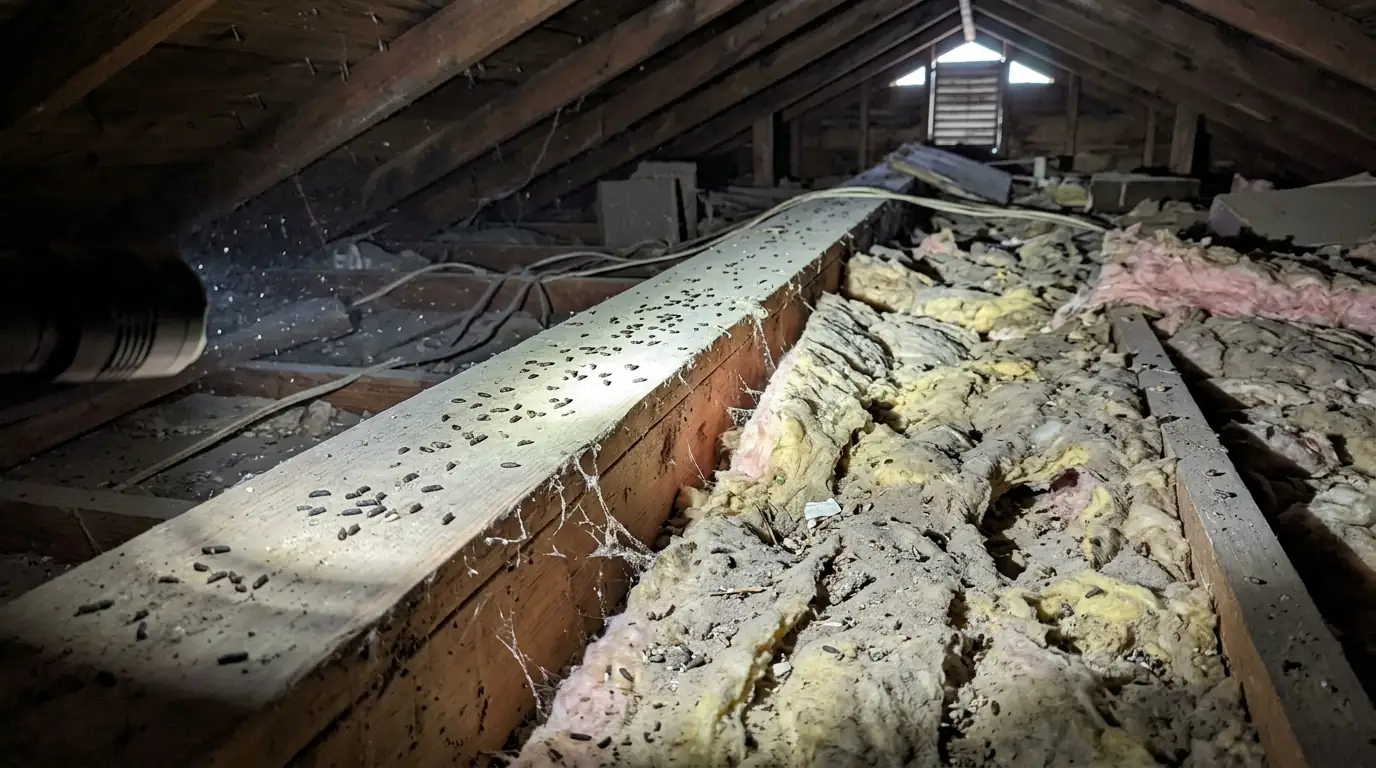
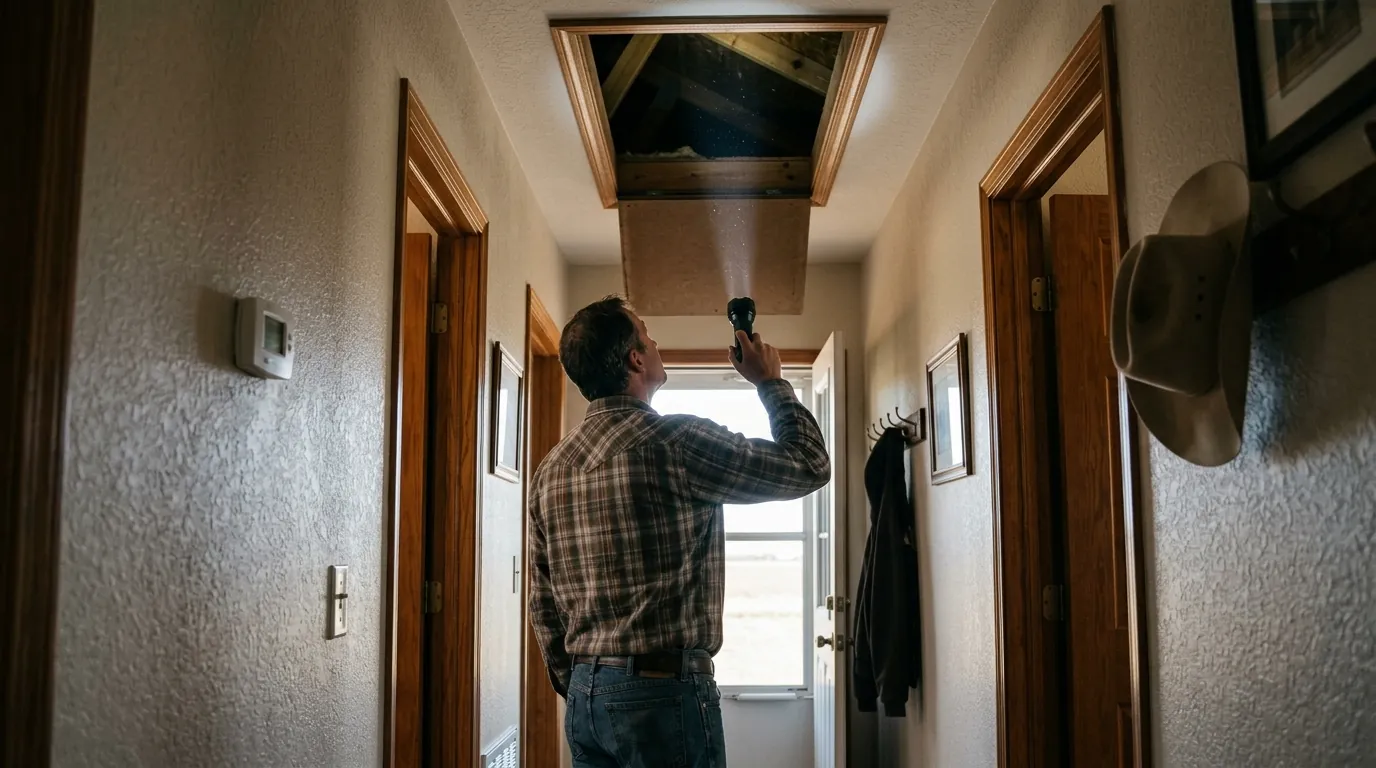
You can learn a lot without climbing into the attic. Stand on the ladder with your head and shoulders through the hatch, a strong flashlight in hand, gloves on and a dust mask if you have one. Do not crawl across the joists or poke at the insulation; just look and sniff.
These are the clues that rodents have been living in the insulation:
- Dark, rice-size droppings scattered across the surface or bunched near the eaves.
- Runways pressed flat through blown insulation, often leading from the eaves toward ducts or the hatch.
- Lumps and tunnels where rodents burrowed under the top layer.
- Yellow or brown patches where urine has soaked in.
- Balls of shredded insulation, paper or fabric tucked into the low corners.
- Wire jackets with bare spots or tooth marks.
- An ammonia or musty smell that hits as soon as the hatch opens.
Why droppings and urine call for wet cleaning, not a broom
Droppings and urine are the main reason attic cleanup is a careful job rather than a quick sweep. Across North America, hantavirus is carried mainly by deer mice, and people catch it by breathing dust from dried droppings, urine or nests that have been stirred up. House mice are widespread around Amarillo too, and nobody can tell whose droppings are whose by looking, so every pile deserves the same caution.
CDC guidance lays out the method. Air the space out for about 30 minutes before starting. Wear rubber or plastic gloves. Never sweep or vacuum dry droppings, since both send contaminated dust into the air. Instead, spray droppings and nesting with a disinfectant or a mix of 1 part bleach to 10 parts water, let it soak, wipe it up and seal everything in bags. That works fine for a handful of droppings on a garage shelf. Spread across a whole attic floor and buried in insulation, it turns into a much bigger project.
Urine adds a second problem. It wicks down through the insulation, sometimes all the way to the drywall, and keeps smelling on hot afternoons long after the rodents have gone.
Packed-down insulation stops doing its job
Insulation slows heat by holding still air between its fibers. When rodents tunnel through it, pack it into runways, drag it into nests or mat it down with urine, that air space collapses. A layer that measured a foot deep when it was blown in can be a few inches thick along a well-used rodent path, and those thin strips let heat pass through the ceiling in both directions.
In Amarillo, both directions matter. Attic air under a dark roof gets very hot on July afternoons, and in winter a strong front can pull the outdoor temperature down 50 to 60 degrees within 12 hours. Snowfall averages 17 to 18 inches a year. A house with tunneled, flattened insulation feels it as rooms that never quite cool off in summer, cold ceilings in winter and a heating and cooling system that runs longer than it used to.
How deep Department of Energy guidance says the insulation should be
Amarillo sits in Department of Energy climate zone 4. For that zone, DOE recommends about R49 to R60 of attic insulation: R60 for an attic with no insulation, and R49 for one that already holds 3 to 4 inches. Soiled insulation that has to come out does not count toward the total, so after a full cleanup the attic is essentially starting from bare.
A quick depth check shows where you stand. From the hatch, look for a depth ruler stapled to a joist, or hold a tape measure upright in an undisturbed spot. Either R target works out to well over a foot of loose-fill insulation. If you measure only a few inches, or the depth swings wildly from one side of the attic to the other, the attic was probably short on insulation even before the rodents arrived.
What happens on an attic cleanup visit
An attic cleanup only makes sense once the rodents are out and the gaps they used are sealed, so that is where our technician starts. If mice are still active, trapping and rodent exclusion come first; otherwise the new insulation just becomes a fresh nest.
From there the work follows the same CDC principles at full scale. The attic is aired out and the route through the house is covered. Droppings and nests are soaked with disinfectant before anything is moved. Contaminated insulation is bagged, sealed and carried out. The bare joists and decking are sanitized and treated with an odor neutralizer, and any raccoon latrine is removed with extra care, since raccoon droppings can carry roundworm eggs. Last, new insulation is blown in to the depth you choose.
Along the way, our technician points out chewed wiring and torn duct wrap so they can be repaired before fresh insulation hides them again.
Why early fall is the right window for attic work
In an average year, Amarillo's first fall freeze arrives around October 20, according to the National Weather Service. As nights cool, house mice that spent the summer in fields and fence lines start hunting for warmth, and attics rank high on their list. Cleaning and sealing the attic in September or early October means newcomers meet closed gaps, and a clean attic leaves no old scent trail to follow.
There is a practical side too. Attic work goes far more smoothly on a mild fall day than in July heat, and finishing before winter means the house starts the heating season under a full, clean layer of insulation instead of a flattened, soiled one. If you are seeing the signs above, call (806) 552-3060 and we will come take a look.
Dolores Lankford, Pest Advice Editor, edits the Pest Advice section for Pestcon, Inc.. Articles are checked against Texas A&M AgriLife, Texas Parks and Wildlife, Texas DSHS, NWS Amarillo and City of Amarillo guidance.
Questions about this article
Can I clean mouse droppings out of attic insulation by myself?
You can handle a few droppings near the hatch by following the CDC steps: air the attic out, wear gloves, soak the droppings in disinfectant or diluted bleach, then wipe and bag them. Once droppings are spread through the insulation itself, it is a different job. Removing that material without stirring up dust takes protective gear, a lot of bagging and long hours in a cramped attic, which is where an attic cleanup service makes sense.
Do a few mouse droppings by the attic hatch mean all the insulation has to go?
Not necessarily. A small cluster of droppings in one spot, with no tunnels, stains or smell anywhere else, can often be handled as a spot cleanup: wet it down, remove that patch of insulation and sanitize the area. Whole-attic replacement makes sense when runways, urine staining and nesting show up across several sections. Our technician walks the full attic before recommending either one, since activity is often heavier near the eaves than at the hatch.
How can I tell if rodents are still in the attic before replacing insulation?
Look and listen for fresh activity. New droppings are dark and shiny, while old ones turn gray and crumbly. Scratching at night, fresh chew marks or snap traps that keep catching all mean rodents are still there. Our technician checks for these signs and confirms entry points are sealed before any cleanup starts, because new insulation in an active attic gets soiled again.
Services that go with this article
Attic Cleanup & Insulation Replacement
Once mice, rats, raccoons, squirrels or bats are gone, the attic they lived in still holds droppings, urine-soaked insulation and a lingering odor.
Rodent Control
Droppings in a kitchen drawer or scratching in the attic at night usually mean house mice, and gnawed feed sacks in a barn often...
Rodent Exclusion & Sealing
Trapping clears the mice inside, but every gap a quarter inch or wider is an open door for the next ones.
Raccoon Removal
Heavy thumping in the attic at night, a torn soffit or a chimney full of chatter usually means a raccoon has moved in.