The Texas WDI report (form SPCS/T-5) when buying or selling a home
If you're buying or selling a house in Amarillo or Canyon, someone will probably mention a WDI report, often called a termite letter.It's a short state form, but it carries real weight in a sale. Here's what the Texas Wood Destroying Insect Report covers, who usually orders it, what the inspector actually looks at and how to fit it into your closing timeline.
By Dolores Lankford, Pest Advice EditorPublished September 9, 2026Updated October 16, 2026
What the Texas WDI report is
The Texas Wood Destroying Insect Report is a state form, numbered SPCS/T-5, issued under the Texas Department of Agriculture's Structural Pest Control Service rules (4 TAC 7.176). It records what an inspector found on a given day about termites and other wood destroying insects in and around a structure.
The rules are specific about the form itself. The report has to be on the department's form and cannot be altered. Photos and extra notes can be attached as an addendum, but the form's own wording stays as written. Copies go to whoever ordered the inspection, and the company that did the inspection keeps its records for at least two years.
Because the form is standardized, every WDI report in Texas follows the same layout. That makes it easier for buyers, sellers, agents and lenders to compare what was found, even when different companies did the inspections.
Who orders the WDI report and who sees it
In most Panhandle home sales the buyer orders the WDI inspection, usually through their agent, as part of the inspections they schedule after the contract is signed. Some lenders and loan programs ask for a WDI report before they'll fund the loan, so your loan officer may bring it up even if you didn't plan on one. Sellers sometimes order one before listing so there are no surprises later.
The report goes to whoever ordered it. If the buyer orders it, the buyer decides whether to share it with the seller, though in practice agents pass it along when repairs or treatment come into the negotiation. If you're a seller who orders a pre-listing report, it's yours to use as you see fit, but think through how a finding would affect your disclosures before you schedule it.
What the inspector looks at during a WDI inspection
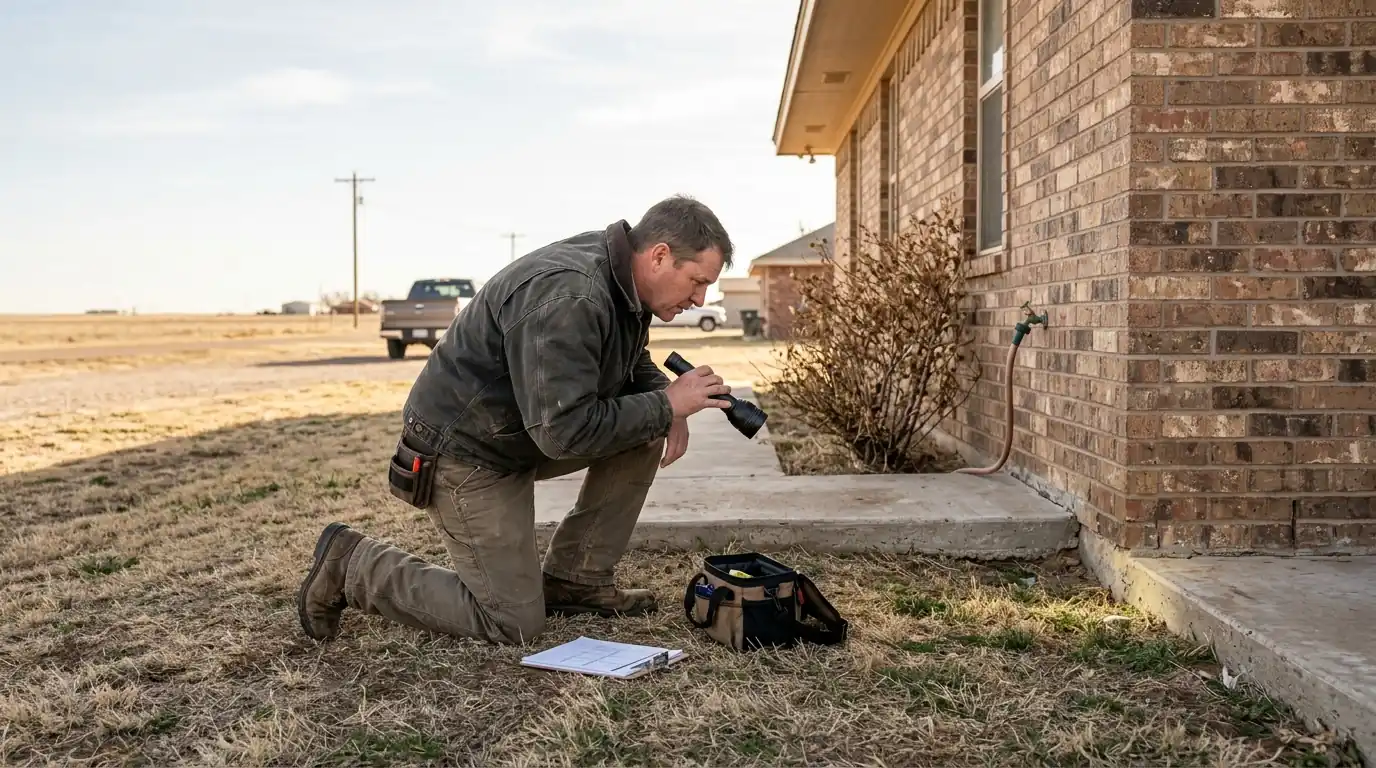
A WDI inspection is a visual inspection of the readily accessible areas of the house and, depending on what was ordered, the garage and other structures on the lot. On a typical Amarillo brick ranch home on a slab, the inspector works around the whole outside, then through the inside and the attic where it can be reached safely. The main things being recorded are:
- Live insects or visible evidence of subterranean termites, such as mud tubes on the slab edge, foundation walls and garage wall plates.
- Damage to wood, including baseboards, door frames, window trim and exposed framing in the garage and attic.
- Evidence of earlier treatment, such as drill holes in the slab or bait stations around the yard.
- Conducive conditions: wood touching soil, soil or mulch above the foundation line, leaks, AC condensate dripping at the slab, and fences or wood piles against the house.
- Areas that couldn't be inspected because of stored items, finished walls, floor coverings, heavy plantings or locked rooms.
- For older pier-and-beam homes, the crawlspace, piers, sill plates and floor framing where access allows.
How to read the findings on the report
The form separates what was seen from what could make an infestation more likely. A report can note no visible evidence of active termites and still list conducive conditions, like a flower bed built up against the brick or a sprinkler that wets the wall every morning. Those notes are worth acting on before you move in, because native subterranean termites live throughout the Panhandle and follow moisture.
Pay attention to the inaccessible areas section too. A garage packed to the ceiling with boxes, a finished basement wall or a crawlspace hatch that's blocked all limit what the inspector can see. The report reflects the conditions on the day of the inspection, based on what was visible and reachable, so it is not a promise that no termites will ever show up.
If the report notes active termites or damage, the next steps usually involve a treatment proposal and possibly a repair estimate from a builder for any damaged wood. Those are separate from the report itself.
Timing the WDI inspection before closing
Buyers usually schedule the WDI inspection early, alongside the general home inspection, so there's time to negotiate if something turns up. If treatment is needed, it can usually be scheduled before closing, and the seller and buyer can agree on who pays as part of the repair negotiation.
Don't leave it to the last week. Lenders sometimes want the report within a certain window before closing, and a finding that shows up late can push a closing date back. If you're unsure about timing, ask your agent or loan officer when the report needs to be in their hands, then schedule the inspection with a few days of cushion.
What to do this week if you have a home under contract
A few small steps make the inspection more complete and the report more useful:
- Confirm with your agent or lender whether a WDI report is required and the date it's due.
- Schedule the WDI inspection on the same day or week as the general home inspection.
- Sellers: clear stored items away from garage walls, the attic hatch and any crawlspace access.
- Sellers: move firewood and lumber away from the house and pull mulch back from the slab edge.
- Have any earlier termite treatment paperwork on hand to share with the inspector.
- Read the conducive conditions section closely, even if no active termites are found.
What our technician does on a WDI visit
Our technician walks the outside of the house first, checking the slab edge, weep holes, door frames, fences, wood piles and any place soil or mulch meets the brick. Inside, they check baseboards, door and window trim, bath traps and plumbing penetrations, the garage wall plates and the attic. For pier-and-beam homes in older parts of town, the crawlspace gets a careful look where access allows.
We complete the findings on the state form and add photos as an addendum, so you and your agent can see exactly what was noted. If there's activity or a conducive condition worth fixing, we explain what it means and what the options are. To set up a WDI inspection on a home you're buying or selling, call (806) 552-3060; we answer 24/7.
Dolores Lankford, Pest Advice Editor, edits the Pest Advice section for Pestcon, Inc.. Articles are checked against Texas A&M AgriLife, Texas Parks and Wildlife, Texas DSHS, NWS Amarillo and City of Amarillo guidance.
Questions about this article
Can a seller's old WDI report from last year be used for my purchase?
It's generally not a good idea. A WDI report reflects conditions on the day of the inspection, and a year is plenty of time for termites to show up or for conditions around the house to change. Lenders that require a report usually want a recent one. A fresh inspection ordered by you, the buyer, gives you current findings and a report that goes directly to you.
What happens to the home sale if the WDI report finds active termites?
The sale doesn't automatically fall apart. A finding usually leads to a treatment proposal and, if wood is damaged, a repair estimate. Buyer and seller then negotiate who pays and when the work gets done, often before closing. Your agent handles that part. Treatment for native subterranean termites is routine, and a documented treatment can make the house easier to sell later.
Services that go with this article
Termite Inspections & WDI Reports
Most Amarillo home sales include a Texas Wood Destroying Insect Report, and many owners want a yearly termite check anyway.
Termite Control
Native subterranean termites live in the soil under Amarillo and work their way into houses through mud tubes you rarely see.
Termite Bait Stations
Termite bait stations sit in the soil around your house and quietly intercept foraging termites before they reach the foundation.
Home Pest Control
Spiders in the garage, crickets at the back door and a mouse behind the stove are everyday problems in Amarillo houses.